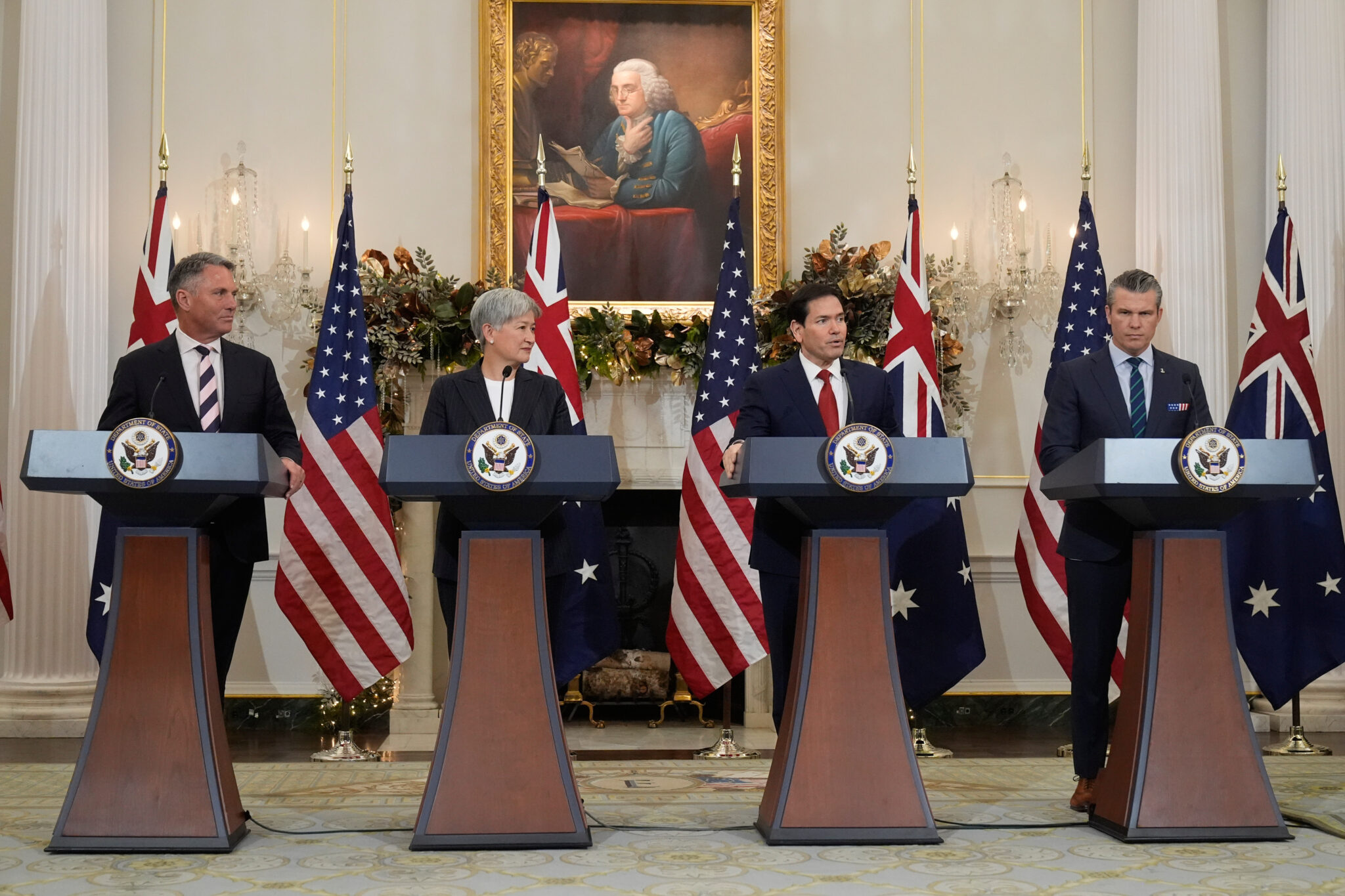
Rubio, Hegseth Host Australia for Security Talks, Eyeing China/ Newslooks/ WASHINGTON/ J. Mansour/ Morning Edition/ U.S. Secretary of State Marco Rubio and Defense Secretary Pete Hegseth met with their Australian counterparts in Washington for annual security talks. Discussions focused on Indo-Pacific stability, defense cooperation, and critical mineral supply chains amid growing concerns over China. The AUKUS submarine pact and recent geopolitical tensions also shaped the agenda.
U.S.-Australia Alliance Quick Looks
- Rubio and Hegseth meet with Australia’s Wong and Marles
- Indo-Pacific security and China’s influence are key concerns
- AUKUS pact and submarine production central to discussions
- Critical minerals agreement a major economic focus
- Russia-Ukraine war and Gaza ceasefire remain global factors
- U.S. strikes on drug networks raise foreign policy questions
- Australia to invest $1B in U.S. submarine production
- UK Foreign Secretary Yvette Cooper to meet Rubio next
- Alliance described as strong, expanding, and essential
- Strategic cooperation growing amid contested global landscape
Deep Look: U.S., Australia Strengthen Strategic Ties as China Shadow Grows
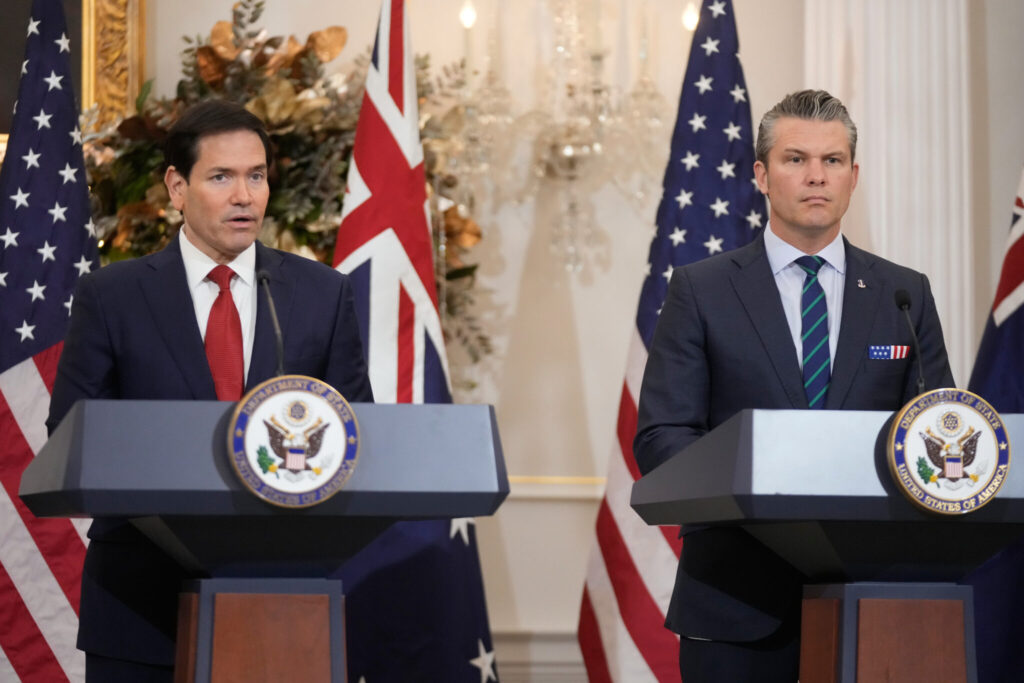
WASHINGTON — U.S. Secretary of State Marco Rubio and Defense Secretary Pete Hegseth hosted their Australian counterparts Monday in Washington for annual bilateral talks, with growing tensions in the Indo-Pacific — and particularly concerns over China’s regional assertiveness — serving as the unspoken backdrop.
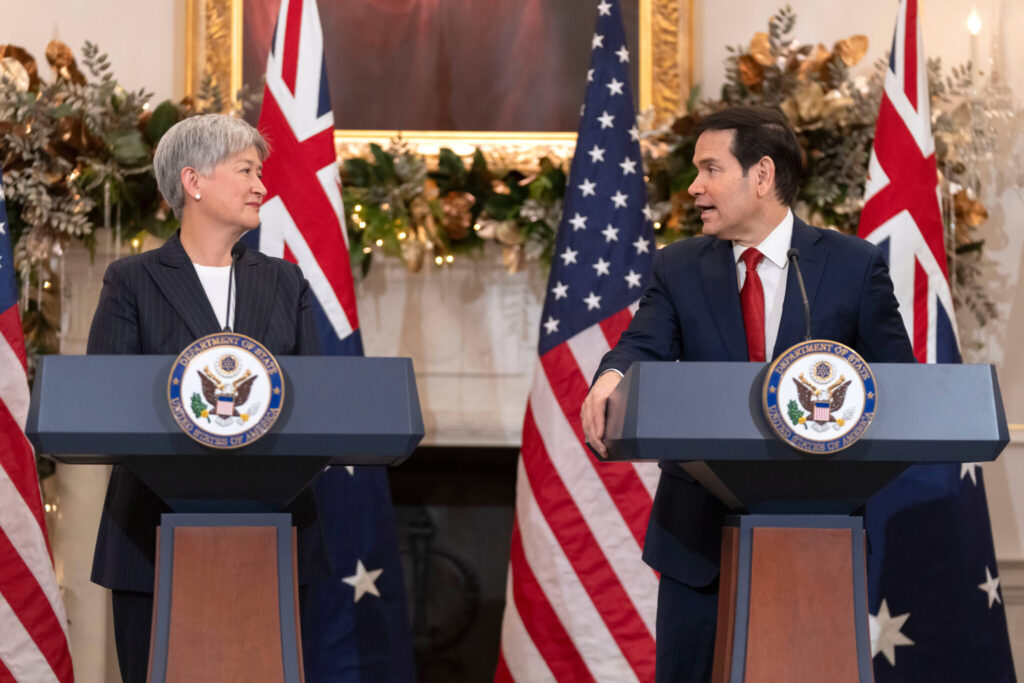
Meeting at the State Department, Rubio and Hegseth were joined by Australian Foreign Minister Penny Wong and Defense Minister Richard Marles to reaffirm the U.S.-Australia strategic alliance. Although none of the four officials explicitly named China during their opening remarks, the country’s rising military posture in the South China Sea and its pressure campaign on Taiwan remain central to both nations’ shared security agenda.
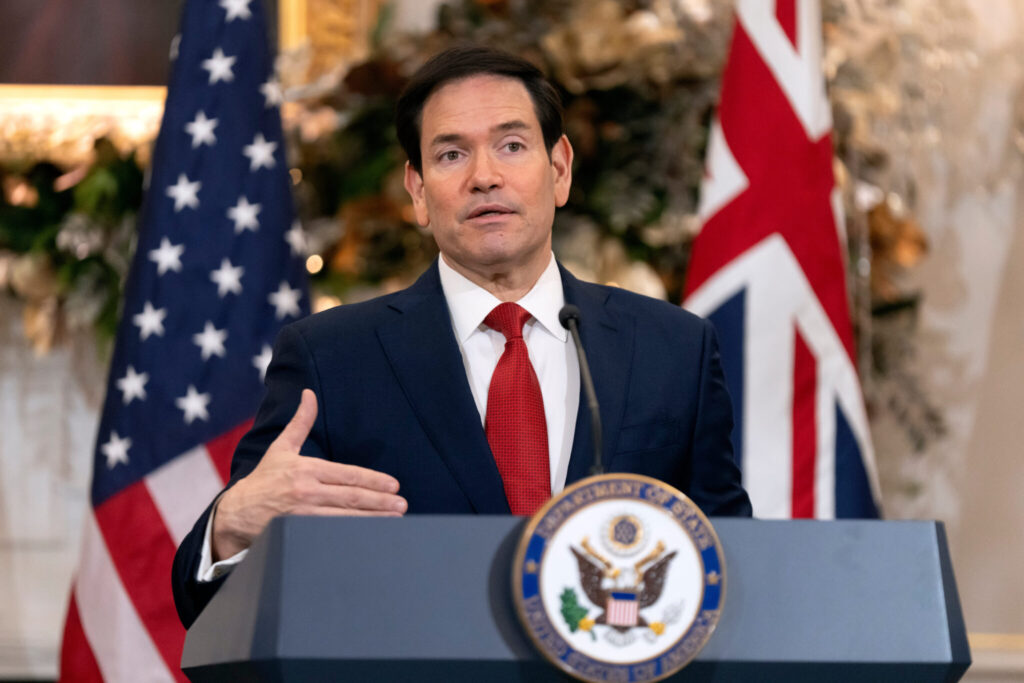
“This is a very strong partnership, it’s a strong alliance, and we want to continue building on it,” Rubio said. He emphasized momentum in joint efforts on critical minerals, defense production, and troop cooperation, pointing to a broader shift in both economic and military priorities across the Indo-Pacific.
While regional flashpoints like the Russia-Ukraine war, the fragile ceasefire in Gaza, and recent U.S. military strikes against drug networks in Latin America also featured in the broader diplomatic backdrop, the Indo-Pacific focus dominated.
Rubio reaffirmed the importance of securing global supply chains for critical minerals—essential for advanced technology, clean energy, and defense equipment—calling reliance on a single source “leverage that can be used against us or our partners.”
The remark referenced China’s recent export restrictions on certain critical minerals, a move softened only after Chinese President Xi Jinping met with President Donald Trump in October. The two leaders agreed to pause the export controls for a year, shortly after Trump signed a critical minerals agreement with Australian Prime Minister Anthony Albanese.
“We have to have supply chains that are diverse and not overly concentrated in one place,” Rubio said.
One of the most high-profile elements of the U.S.-Australia alliance is the AUKUS agreement — a trilateral security pact between the United States, United Kingdom, and Australia that includes plans to build a fleet of nuclear-powered submarines for Australia using American technology. Originally launched during the Biden administration, the pact continues to play a central role under Trump’s renewed foreign policy direction.
Wong described AUKUS as “a win for Australia, a win for the U.S., and a win for the United Kingdom,” reaffirming that work on the program is moving forward “full steam ahead.”
Hegseth echoed that message, highlighting Australia’s planned $1 billion investment to expand U.S. submarine production capacity. “We’re strengthening AUKUS so it works for all three partners,” he said.
Defense Minister Marles added that growing global instability only underscores the need for tight cooperation with allies like the U.S.
“We are living in a much more contested world,” Marles said. “It really matters to be doubling down with friends and allies, and obviously America is front and center and foremost for Australia in that respect.”
Following the U.S.-Australia talks, Rubio was scheduled to meet later Monday with UK Foreign Secretary Yvette Cooper, likely to continue discussions around AUKUS and broader Indo-Pacific policy alignment.
The meeting comes at a time of strategic recalibration for both countries, as shifting power balances in the Asia-Pacific region prompt Washington and Canberra to solidify joint deterrence measures while deepening economic cooperation in key industries like rare earth minerals and defense technology.
As the alliance adapts to new global pressures, leaders on both sides stressed continuity, shared values, and a renewed urgency to work in lockstep.