Trump: US Now Deciding What’s Next for Venezuela, ‘We’ll Be Involved in it Very Much’ / Newslooks/ WASHINGTON/ J. Mansour/ Morning Edition/ The United States launched a large-scale military strike on Venezuela and captured President Nicolás Maduro and his wife. President Donald Trump announced the operation overnight, triggering global reactions and legal questions. Maduro now faces U.S. criminal charges as Venezuela reels from shock and uncertainty.
US Strikes Venezuela Quick Looks
- The U.S. carried out a large-scale overnight strike in Caracas.
- President Nicolás Maduro and his wife were captured and flown out.
- Donald Trump announced the operation on Truth Social.
- Maduro faces U.S. narcoterrorism and weapons charges.
- FAA restricted airspace in Puerto Rico due to security concerns.
- Trump dismissed criticism over lack of congressional approval.
- Maduro was seized at his home inside a military installation.
- Global leaders reacted with concern, condemnation, and caution.
- Celebrations erupted among Venezuelans in South Florida.
- Protests and fear spread across Caracas following explosions.
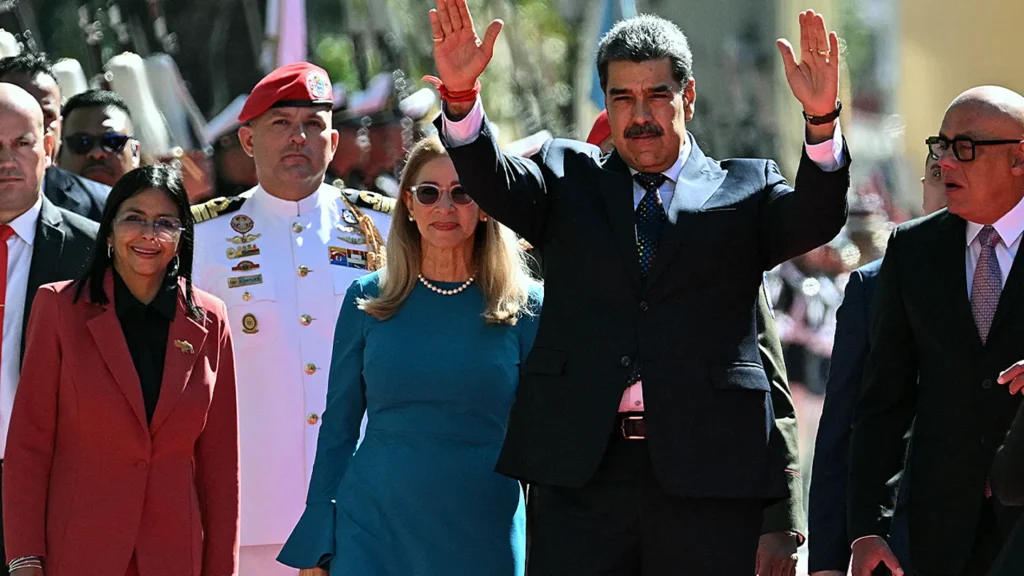
Trump: US Now Deciding What’s Next for Venezuela, ‘We’ll Be Involved in it Very Much’
Deep Look
The United States launched a dramatic overnight military operation in Venezuela early Saturday, striking targets in Caracas and capturing President Nicolás Maduro and his wife, Cilia Flores. The unprecedented action was announced hours later by President Donald Trump on social media, marking one of the most extraordinary foreign interventions by the U.S. in decades.
Trump revealed the operation shortly after 4:30 a.m. Eastern time, saying Maduro and his wife had been captured and flown out of the country in coordination with U.S. law enforcement. He later confirmed that the couple was being transported aboard a U.S. warship to New York, where Maduro will face long-standing criminal charges.
The legal basis for the strike remains unclear, as does whether Congress was consulted beforehand. The speed and scope of the operation drew immediate comparisons to the 1990 U.S. invasion of Panama, when American forces captured leader Manuel Noriega and brought him to the United States to stand trial.
U.S. Attorney General Pam Bondi said Maduro and Flores will face the “full wrath of American justice,” citing a 2020 federal indictment accusing Maduro of narcoterrorism, cocaine trafficking conspiracies, and weapons offenses. Prosecutors previously alleged that Maduro turned Venezuela into a criminal enterprise serving drug traffickers and militant groups.
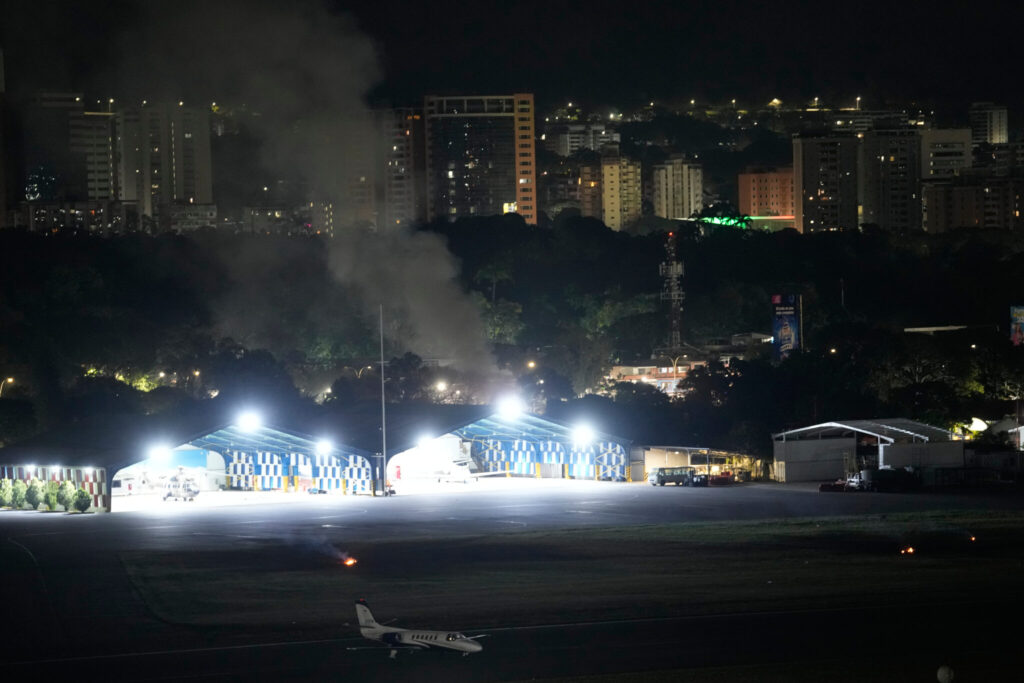
Explosions rocked Caracas before dawn, with at least seven blasts reported near military installations, including Fort Tiuna, the country’s main garrison. Residents described aircraft flying low over the city as the attack unfolded. The strike lasted less than 30 minutes, though it left large sections of the capital tense and uncertain.
Venezuelan officials said Maduro was seized at his residence inside the Ft. Tiuna military complex. Ruling party leaders described the operation as a kidnapping, while Vice President Delcy Rodríguez said the government did not know the whereabouts of Maduro or Flores and demanded proof of life.
The fallout spread quickly beyond Venezuela. The Federal Aviation Administration imposed temporary airspace restrictions around Puerto Rico’s main international airport, citing security concerns tied to military activity. Several U.S. airline flights were suspended or canceled as a precaution.
Trump dismisses criticism he did not seek congressional permission for Venezuela strike
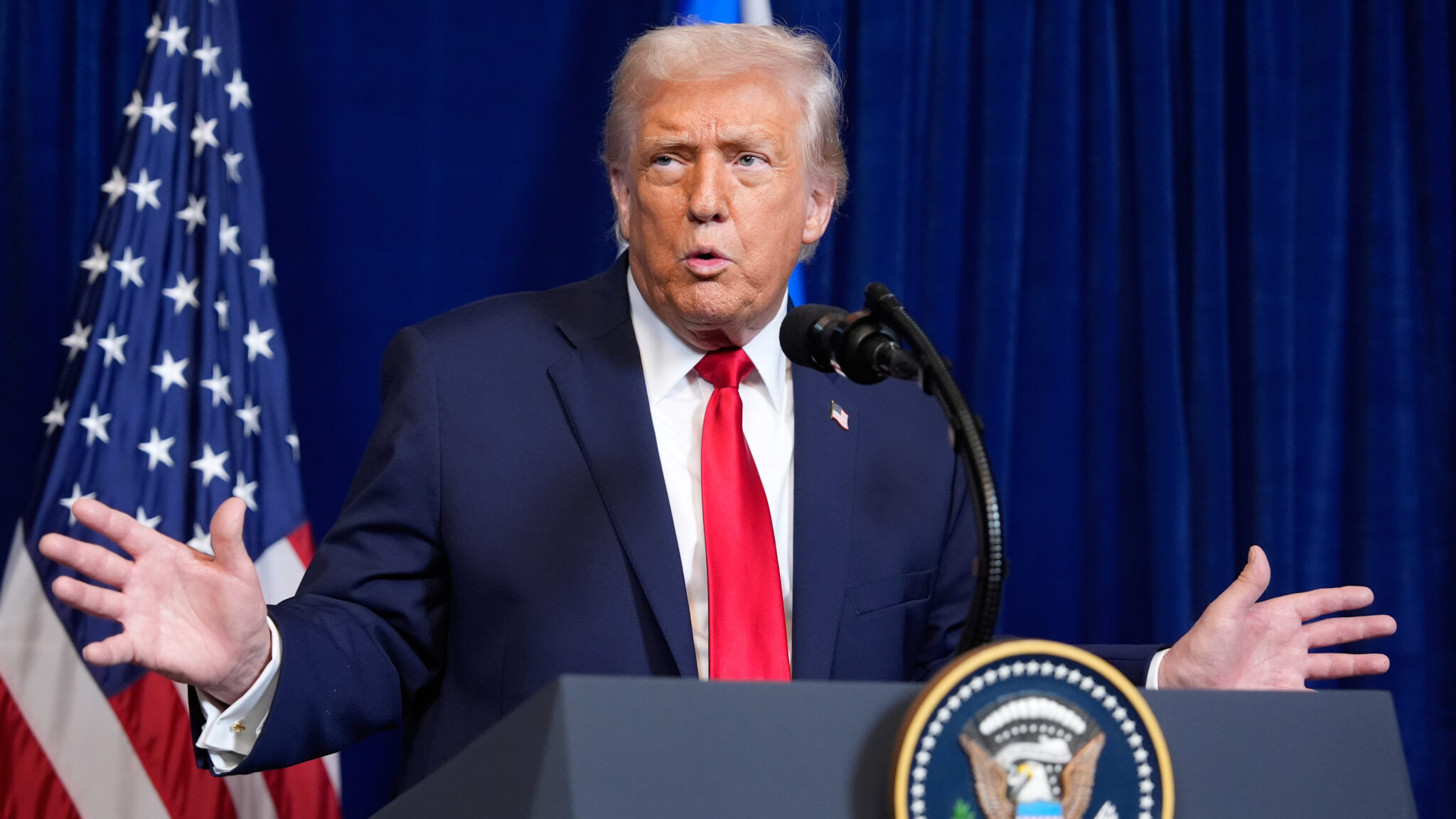
Trump brushed off criticism from Democratic lawmakers who questioned the legality of the strike, calling the operation “genius” and dismissing constitutional concerns. He said the U.S. would play a significant role in determining Venezuela’s future leadership, arguing that allowing remnants of Maduro’s regime to remain would pose risks.
He said the operation in Venezuela was “really genius.”
“All they do is complain,” he said of the Democrats.
“They should say, ‘Great job.’ They shouldn’t say, ‘Oh Gee, maybe it’s not constitutional.’ You know, the same old stuff that we’ve been hearing for years and years and years,” Trump said.
Trump says he proposed to the Mexican president that US take out cartels
Trump said the operation in Venezuela “wasn’t meant to be” a message to Mexico, but then he has proposed to Mexican President Claudia Sheinbaum that the U.S. “take out” cartels in her country and suggested the U.S. might take action.
“We’re very friendly with her, she’s a good woman. But the cartels are running Mexico. She’s not running Mexico. The cartels are running Mexico,” Trump said.
He said he’s asked Sheinbaum numerous times, “Would you like us to take out the cartels?” but she has said no.
“Something’s going to have to be done with Mexico,” Trump said.
Maduro and his wife are on a US warship, Trump says
Trump told Fox News that the couple were aboard the U.S. warship Iwo Jima and headed to New York, where they will face prosecution.
Trump says some US forces injured in Venezuela strike but he believes ‘we had nobody killed’
Trump says US will decide on what’s next for Venezuela
Trump said in an interview Saturday morning that the United States will be making decisions on what is next for Venezuela after capturing the Latin American country’s president and flying him out of the country.
“We’ll be involved in it very much” as to who will govern the country, Trump said.
“We can’t take a chance in letting somebody else run and just take over what he left, or left off,” Trump said in an interview with Fox News hours after the capture.
Maduro was at his home when he was seized in US operation, party leader tells AP
Venezuelan ruling party leader Nahum Fernández told The Associated Press that Nicolás Maduro and his wife were at their home within the Ft. Tiuna military installation when they were captured.
“That’s where they bombed,” he said. “And, there, they carried out what we could call a kidnapping of the president and the first lady of the country.”
Vice President JD Vance says Maduro found out that Trump ‘means what he says’
Vice President JD Vance praised the operation, saying Maduro ignored repeated warnings to halt drug trafficking and return stolen oil revenues. U.S. officials said they expect no further military action now that Maduro is in custody.
US indicted Maduro on narcoterrorism charges in 2020
The Justice Department during Trump’s first term in office charged in the several indictments that Maduro had effectively converted Venezuela into a criminal enterprise at the service of drug traffickers and terrorist groups as he and his allies stole billions from the South American country.
The coordinated unsealing of indictments against 14 officials and government-connected individuals, and rewards of $55 million for Maduro and four others, attacked all the key planks of what then-Attorney General William Barr called the “corrupt Venezuelan regime,” including the Maduro-dominated judiciary and the powerful armed forces.
One indictment by prosecutors in New York accused Maduro and socialist party boss Diosdado Cabello, head of the rubber-stamping constitutional assembly, of conspiring with Colombian rebels and members of the military “to flood the United States with cocaine” and use the drug trade as a “weapon against America.”
Read our news report from 2020 on the charges
State Department officials say ‘the tyrant is gone’
U.S. Deputy Secretary of State Christopher Landau says the military action and seizure of Maduro marks “a new dawn for Venezuela,” saying that “the tyrant is gone.”
He posted on X hours after the strike. His boss, Secretary of State Marco Rubio, reposted a post from July that said Maduro “is NOT the President of Venezuela and his regime is NOT the legitimate government.”
Global Reactions
International reaction was swift and divided. European leaders urged restraint and respect for international law, while Russia condemned the strike as armed aggression and called for an emergency U.N. Security Council meeting. Colombia began preparing for a possible influx of refugees, deploying forces to its border.
Inside Venezuela, reactions were mixed. Pro-government supporters gathered in Caracas demanding Maduro’s return, while many residents expressed fear and uncertainty. Streets were largely empty as people assessed the magnitude of the events.
Outside the country, Venezuelan expatriates in South Florida celebrated openly, waving flags and chanting for freedom at rallies in Doral, home to the largest Venezuelan community in the United States.
As dawn broke over Caracas, the future of Venezuela remained unclear. With Maduro removed and facing prosecution in the United States, Washington signaled that a new chapter had begun — one that could reshape the political landscape of Latin America.