Kushner’s Ambitious Gaza Rebuilding Plan Faces Major Roadblocks/ Newslooks/ WASHINGTON/ J. Mansour/ Morning Edition/ Jared Kushner unveiled a fast-track vision to rebuild Gaza into a modern coastal hub with high-rises, tourism zones, and a new port. But the plan faces major obstacles, including ongoing insecurity, Hamas disarmament uncertainty, and Gaza’s massive destruction and rubble. Experts also question where civilians would live during rebuilding and whether Israel would accept Kushner’s proposed redevelopment.
Kushner Gaza Rebuilding Plan – Quick Looks
- Kushner says Gaza could be rebuilt in three years if security is achieved.
- The UN estimates 60+ million tons of rubble, requiring 7+ years just to clear.
- Reconstruction depends on Hamas demilitarization, which remains unresolved.
- Kushner’s plan includes new housing zones, tourism areas, roads, airport, and port.
- No clear details on demining, temporary housing, or civilian relocation.
- Gaza’s current population is largely displaced along the coastline and Gaza City areas.
- Rebuilding cost estimate: $70 billion (UN, EU, World Bank).
- Israel’s political and security objections could block key elements, including high-rise development.

Kushner’s Ambitious Gaza Rebuilding Plan Faces Major Roadblocks
Deep Look
JERUSALEM — Jan. 23, 2026 (AP) — Jared Kushner, senior adviser to U.S. President Donald Trump and a key architect of Middle East policy, has unveiled a sweeping vision for postwar Gaza: sleek high-rises, a bustling Mediterranean port, and a modern economy. But experts and aid agencies say the plan faces overwhelming obstacles — from unresolved security concerns to massive physical destruction.
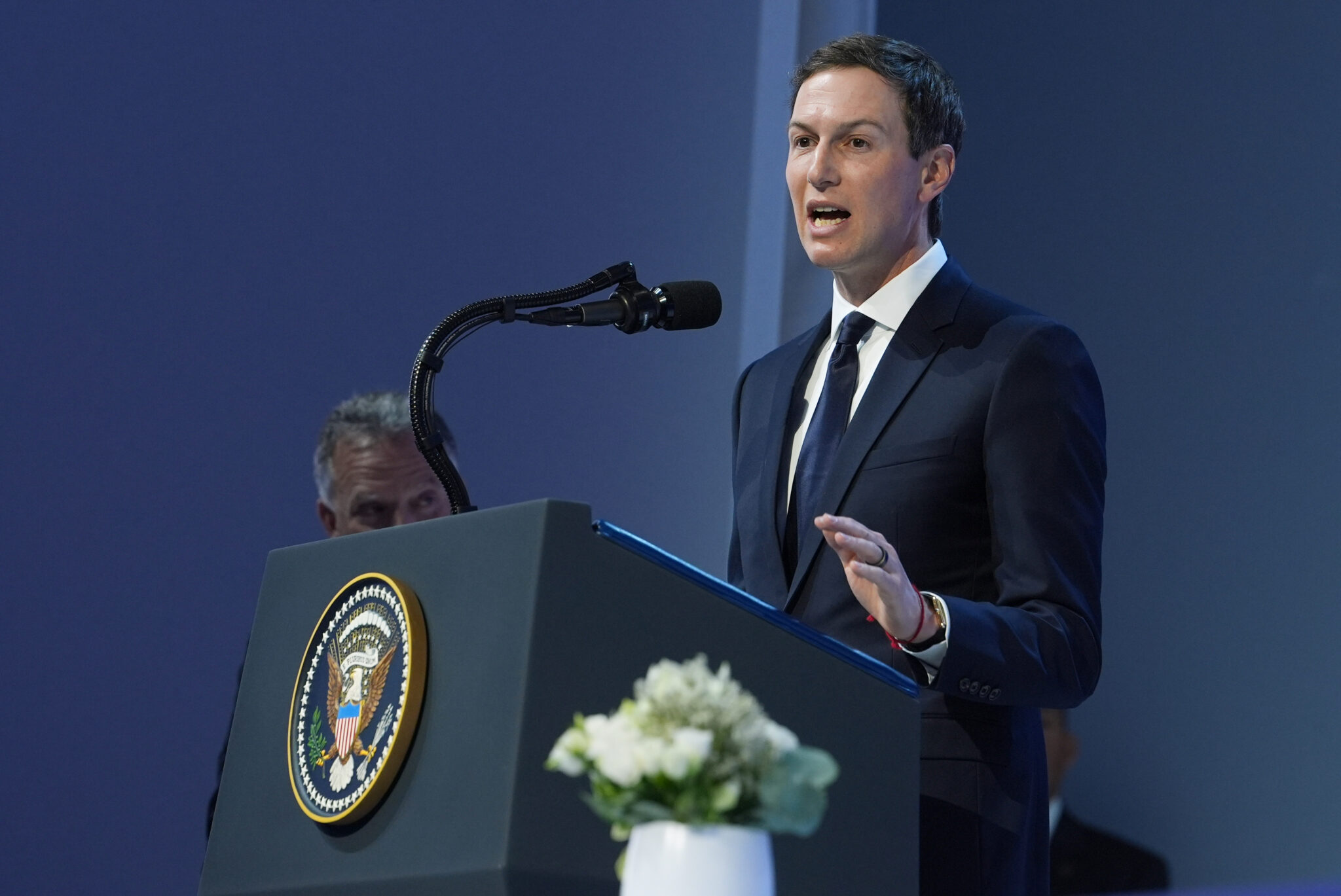
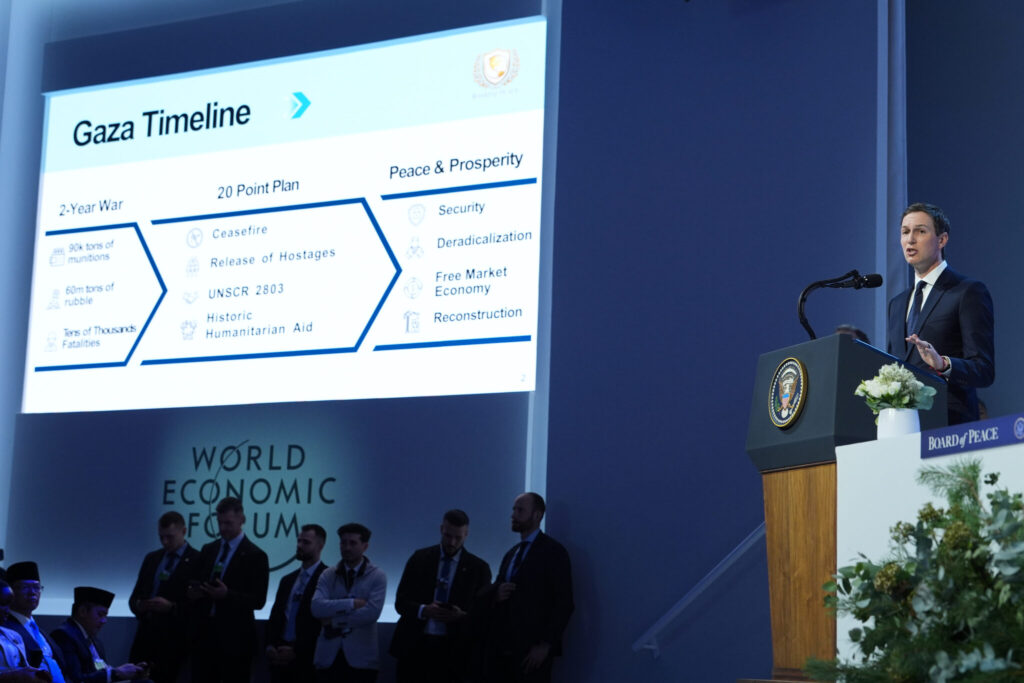
Speaking at the World Economic Forum in Davos on Thursday, Kushner presented his vision for a “New Gaza,” saying full reconstruction could happen within just three years — if security is established.
“In the Middle East, they build cities like this in three years,” Kushner said, referencing Gulf megaprojects. “And so stuff like this is very doable, if we make it happen.”
But Is It?
That optimistic timeline sharply contrasts with ground realities. According to the U.N., Gaza currently holds over 60 million tons of rubble, enough to fill nearly 3,000 cargo ships. Demining experts say unexploded ordnance is scattered across the territory, posing daily threats to civilians. The UN Office for Project Services estimates that clearing debris alone could take more than seven years, followed by years of reconstruction.
Security: The Plan’s Fragile Foundation
Kushner’s plan hinges on one critical factor: security.
He acknowledged that reconstruction is impossible without it — yet Gaza remains volatile. While a ceasefire has held since October 10, daily clashes continue. Israeli forces have killed at least 470 Palestinians since the ceasefire began, according to Gaza’s Health Ministry. Israel claims it has responded to ceasefire violations.
Meanwhile, Hamas — which has ruled Gaza since 2007 — has signaled openness to “freezing” weapons but has not agreed to disarm. Competing armed groups in the enclave, some armed by Israel to weaken Hamas, add further complexity.
The U.S.-backed National Committee for the Administration of Gaza (NCAG) is intended to oversee the transition to a reformed Palestinian Authority, but it’s unclear how much authority it will wield — or if Hamas will yield control.
Kushner said the Board of Peace, created to oversee the ceasefire and rebuilding process, is working on de-escalation strategies with Israel, and views demilitarization as the next priority. However, no specifics were provided about disarmament timelines or enforcement mechanisms.
What Happens to Gaza’s People?
While Kushner painted a glossy picture of futuristic cities, his presentation lacked details on how nearly 2 million displaced Palestinians would survive in the short term.
He made no mention of where civilians would live while their neighborhoods are rebuilt, how they would access clean water, or how widespread disease — exacerbated by destroyed sanitation infrastructure — would be addressed.
In fact, some of the areas Kushner envisions for new tourist districts and business hubs are currently where many Palestinians are taking shelter.
He did say that the first construction phase would begin in Rafah, the southern city devastated by war and now under Israeli military control. Rubble-clearing and demolition are “already underway” there, he said. Next would come Gaza City, dubbed “New Gaza” in Kushner’s slides — envisioned as a tech-enabled, job-rich urban center.
His vision includes:
- Eight new residential districts
- Agricultural zones and parks
- Sports facilities and entertainment centers
- An international airport and a modern seaport
- A business district with “data centers,” “advanced manufacturing,” and an “industrial complex”
What About Demining?
Despite the extensive presence of unexploded munitions, Kushner’s plan does not mention demining efforts. The United Nations and rights groups have warned that cleanup in densely populated areas has not even begun — largely because Israel has restricted the entry of heavy equipment and aid workers.
Aid groups say that until the area is made safe, residents cannot safely return to their homes, let alone begin rebuilding.
Massive Price Tag, Unclear Investors
The latest joint estimate from the UN, European Union, and World Bank places the cost of reconstruction at $70 billion — and Kushner admits no rebuilding will start in areas that aren’t fully disarmed. Without guarantees of security, he said, investors won’t come and jobs won’t materialize.
But so far, few international donors have signed on, and most nations remain cautious amid the region’s instability and lack of consensus over Gaza’s political future.
Israeli Opposition Likely
Kushner’s plan also appears out of step with Israel’s strategic preferences. International conflict expert Nomi Bar-Yaacov called the vision “completely unrealistic,” suggesting it reflects more of a real estate developer’s fantasy than a peacemaking strategy.
“High-rise buildings in Gaza with views into Israeli military installations? That’s a nonstarter for Israel,” she said. Bar-Yaacov, a senior fellow at the Geneva Centre for Security Policy, added that Kushner’s assumption that the Palestinian Authority (PA) would eventually govern Gaza contradicts Israeli Prime Minister Benjamin Netanyahu’s stance. Netanyahu has repeatedly rejected any postwar Gaza plan involving the PA.
Even within the West Bank, where the PA governs, its credibility has been eroded by accusations of corruption and close cooperation with Israeli forces. Many Palestinians do not see the PA as a legitimate alternative to Hamas.
Conclusion: Vision Without a Path?
Kushner’s presentation at Davos offered a bold, ambitious picture of a Gaza transformed — but left unanswered critical questions about who will pay for it, how the war-torn territory will be secured, and whether key regional players are on board.
As the Board of Peace takes shape and international discussions continue, observers say the hard work of diplomacy, trust-building, and logistics planning has barely begun.