Trump Dominates Davos Amid Global Tensions and Debate/ Newslooks/ WASHINGTON/ J. Mansour/ Morning Edition/ President Trump commanded attention at Davos 2026 with bold rhetoric and geopolitical moves. He sparked global debates on Arctic security, peace efforts, and trade tensions with Europe. While business leaders discussed AI optimism, Trump’s presence redefined the forum’s political focus.

Trump at Davos 2026 – Quick Looks
- Trump made a 24-hour appearance at the World Economic Forum in Davos
- Delivered a hyperbolic speech, shifting political focus away from AI and climate
- Criticized and praised by world leaders, including Zelenskyy and Newsom
- Backpedaled on controversial Greenland annexation plan after backlash
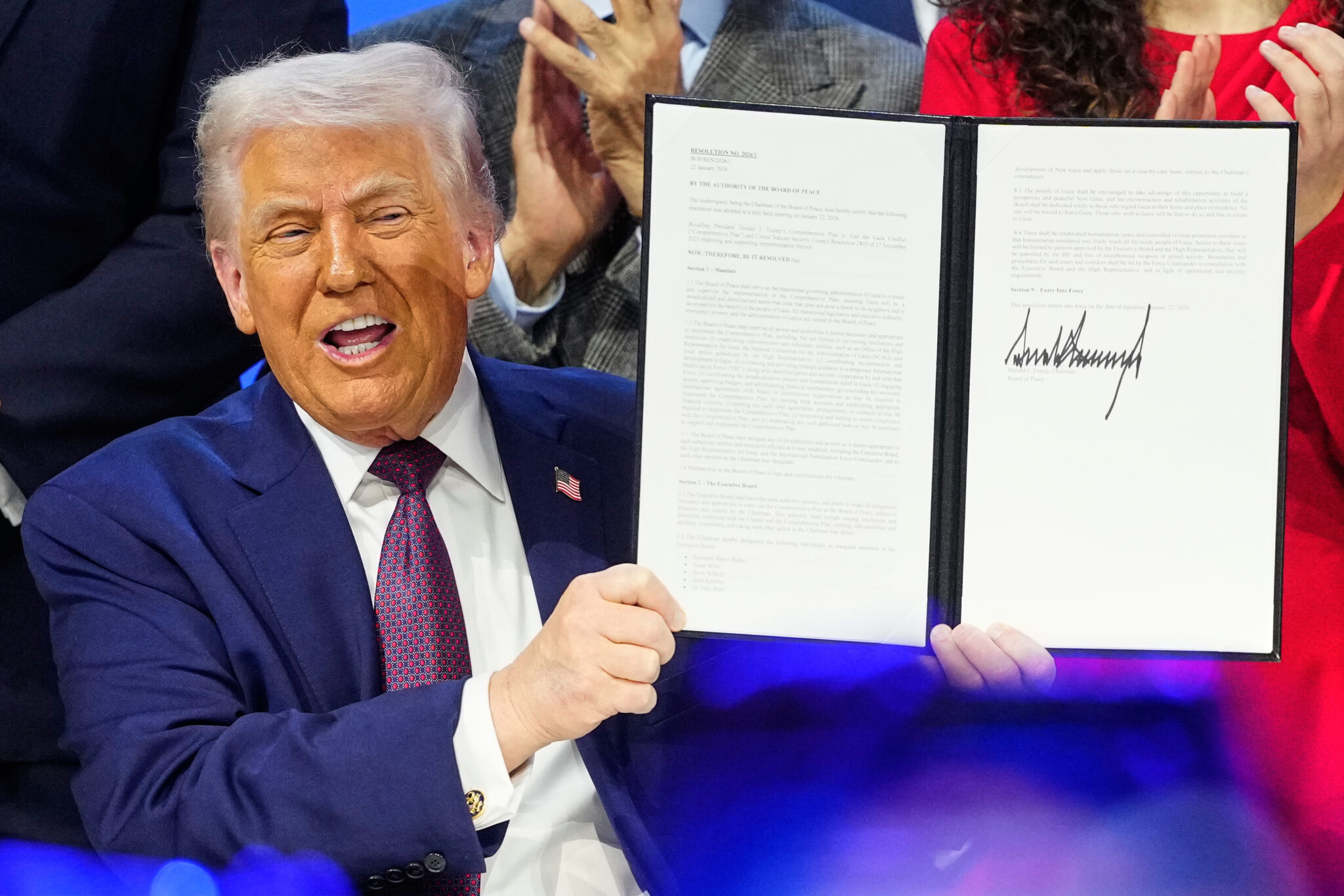
- Introduced “Board of Peace” for Gaza, sparking skepticism from U.S. allies
- Tech and AI leaders like Elon Musk and Jensen Huang also headlined sessions
- AI optimism dominated business dialogue despite policy tensions
- Closing remarks urged hope, quoting Musk’s optimistic philosophy
Deep Look: Trump Steals Spotlight at Davos 2026 with Bold Moves, Mixed Reaction
DAVOS, Switzerland (Jan. 23, 2026) — The snow-covered Swiss Alps hosted the world’s top political and business elites this week at the World Economic Forum in Davos, but one name loomed larger than all others: Donald Trump.
The U.S. President’s high-octane return to Davos, his third visit while in office, transformed the elite gathering into a global spectacle. With a mix of bombastic statements, diplomatic pivoting, and unconventional initiatives, Trump managed to overshadow conversations about artificial intelligence, climate change, and renewable energy — themes that usually dominate the forum.
Trump’s Geopolitical Stage Performance
During his brief, 24-hour visit, Trump delivered a rambling but forceful speech that promoted U.S. leadership and highlighted his administration’s foreign policy actions. While his presence excited some, it unsettled others, particularly European leaders.
“There were two Davoses this year,” said Jane Harman, a former U.S. congresswoman. “One was focused on AI and business transformation. The other — geopolitics — was dominated entirely by Trump.”
California Governor Gavin Newsom countered Trump’s narrative in press sessions, highlighting domestic and international opposition to the President’s agenda. But not all reactions were negative. NATO Secretary-General Mark Rutte and Ukrainian President Volodymyr Zelenskyy praised Trump’s efforts to support Ukraine and bolster NATO’s defense posture.
Greenland Flare-Up and Walkback
In the days leading up to Davos, Trump sparked controversy by announcing tariffs on eight European nations opposing his revived attempt to acquire Greenland, the semi-autonomous Danish territory.
His remarks—claiming the U.S. should obtain “right, title, and ownership” of the Arctic land—alarmed NATO allies and raised concerns about U.S. foreign policy stability. However, facing pressure at home and abroad, Trump quickly reversed course.
He later posted on Truth Social that he had reached a “framework of a future deal” on Arctic security with NATO’s Rutte, suggesting a return to diplomacy, though the specifics remain unclear.
“Board of Peace” Raises Eyebrows
Another key announcement was Trump’s launch of a “Board of Peace”, aimed at facilitating a ceasefire in the Israel-Hamas conflict and crafting a governance plan for post-war Gaza. Trump positioned the board — chaired by himself — as an alternative to the United Nations.
The initiative attracted support from Belarus, Kosovo, Indonesia, and Argentina, but also prompted sharp criticism from European allies who questioned its legitimacy, transparency, and overlap with existing global institutions.
“This was a poor and sad attempt to replicate the founding of the U.N.,” said Agnes Callamard, Secretary-General of Amnesty International.
AI and Tech: The Business Davos Still Thrives
While politics dominated headlines, artificial intelligence remained a core focus for the business elite. Tech moguls like Elon Musk and Nvidia CEO Jensen Huang made their Davos debuts, energizing the forum with forward-looking optimism.
Musk, previously dismissive of Davos as “boring,” made a surprise appearance to discuss robotics, AI’s energy demands, and gently criticize the Trump administration for tariffs on Chinese solar panels.
Huang addressed concerns over AI-driven job losses, insisting that the sector would create millions of new infrastructure roles, from electricians to network technicians.
Meanwhile, Anthropic CEO Dario Amodei stoked controversy by comparing the Trump administration’s decision to allow Nvidia chip sales to China to selling nuclear weapons to North Korea — a stark critique highlighting global AI tensions.
A Closing Note on Optimism
Despite deep divides over politics and power, Davos closed on a hopeful note. Forum co-chair and BlackRock CEO Larry Fink quoted Elon Musk in his final remarks:
“It’s better to be an optimist and wrong than a pessimist who’s right.”
That message echoed throughout the business community at Davos, even as geopolitical risks — from Arctic ambitions to Middle Eastern peace initiatives — underscored the challenges ahead.