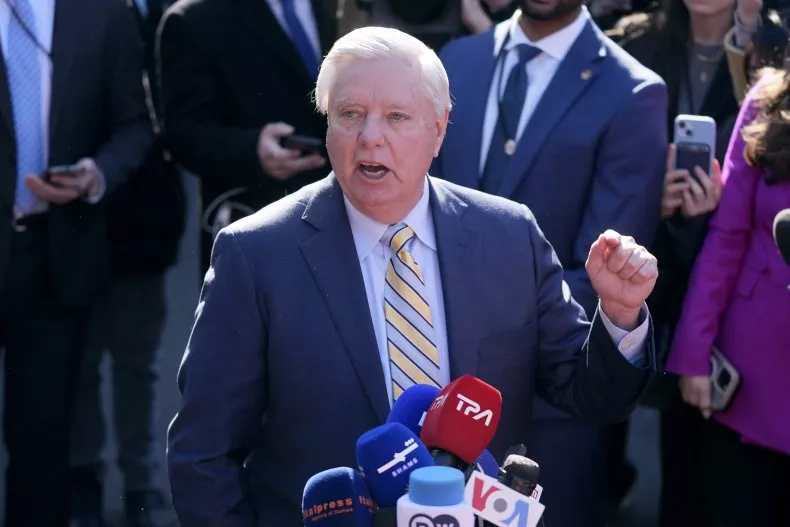
Graham Pushes Amendment Votes to End Funding Standoff/ Newslooks/ WASHINGTON/ J. Mansour/ Morning Edition/ Sen. Lindsey Graham has offered to lift his blockade on a crucial government funding bill if he receives votes on specific amendments. The South Carolina Republican’s demands relate to immigration enforcement and privacy protections for senators. His shift could help avoid a last-minute government shutdown.
Lindsey Graham Shutdown Standoff Quick Looks
- Graham signals openness to funding deal with amendment votes.
- Wants votes on sanctuary city policies and Jack Smith probe fallout.
- Objections had been key roadblock to Senate passing spending bill.
- GOP leaders eye Senate vote today to meet funding deadline.
- Graham wants protections for senators’ phone data and notification rights.
- A House-passed provision removing $500K damage payouts sparked his pushback.
- All 99 senators must agree to allow amendment votes.
- Trump and Senate Democrats support the overall funding package.
- House Rules Committee to prep for Monday floor vote.
- Final GOP strategy to be discussed in afternoon call.
Deep Look
Lindsey Graham Offers Deal to End Shutdown Threat Over Spending Bill Amendments
WASHINGTON, D.C. — Senator Lindsey Graham (R-S.C.) has outlined a potential path forward to pass a critical government funding bill, easing tensions in a standoff that threatened to trigger a government shutdown within hours.
Graham, who has emerged as the chief holdout in the Senate, said Friday he would drop his blockade if he’s granted floor votes on three amendments — a move that could allow the Senate to send the bill to the House in time to avert a shutdown.
The three amendments include:
- A measure targeting sanctuary cities that don’t comply with federal immigration laws.
- Two changes related to the now-defunct 2020 election investigation led by former special counsel Jack Smith.
“Give Me a Vote”
“I’m asking this body to guarantee me that vote, and we move forward,” Graham said on the Senate floor, referring to his sanctuary cities proposal.
Graham also addressed the more controversial aspect of the spending bill — a House-passed provision that repeals a law allowing senators to sue for damages (up to $500,000) if their phone records are subpoenaed without notification, as happened during the Smith probe.
Graham, who was among the senators whose phone data was seized, insisted the issue is not personal but about broader privacy protections. “It’s not about me — 190 private groups had their phone records messed with,” he said. “I want notification.”
He proposed alternative language that would expand who can sue if impacted and require agencies to notify senators when their records are accessed.
“We’ll fix the $500,000 — count me in — but you took the notification out,” Graham said. “I am demanding a vote on the floor of the United States Senate.”
Senate Republicans Seek Unity Before Deadline
Graham’s reversal comes less than 24 hours after he railed against the bill as a “bad deal” and vowed to delay its passage. As of Thursday night, he was viewed as the main obstacle to getting the agreement through the Senate before the funding deadline.
Under Senate rules, unanimous consent is needed to expedite the amendment votes Graham is requesting, meaning all 99 other senators must agree.
Despite the hurdles, Senate Republican leaders are cautiously optimistic. GOP aides say that granting Graham his votes could clear the path for a final vote later today.
House Prepares for Weekend Action
Assuming the Senate passes the funding deal, the House Rules Committee is scheduled to meet Sunday at 4 p.m. to prepare for floor action, according to three individuals familiar with internal discussions.
That timeline would enable the House to vote Monday and send the legislation to President Donald Trump, who supports the bipartisan agreement crafted with Senate Democrats.
GOP leaders are planning to finalize the legislative strategy during a Republican conference call scheduled for 4:30 p.m. Friday.
Backdrop: Fallout from Jack Smith Probe
Graham’s protest stems in part from backlash to the provision rolling back legal protections related to data seizures from senators during the Jack Smith special counsel investigation into alleged 2020 election interference.
That provision was quietly added to the House-passed spending bill and later included in the Senate deal.
Graham, whose communications were targeted in the probe, took issue not with the damages clause being removed but with the lack of safeguards moving forward. He emphasized the need for notification when lawmakers are under federal scrutiny, claiming it’s a matter of institutional integrity.