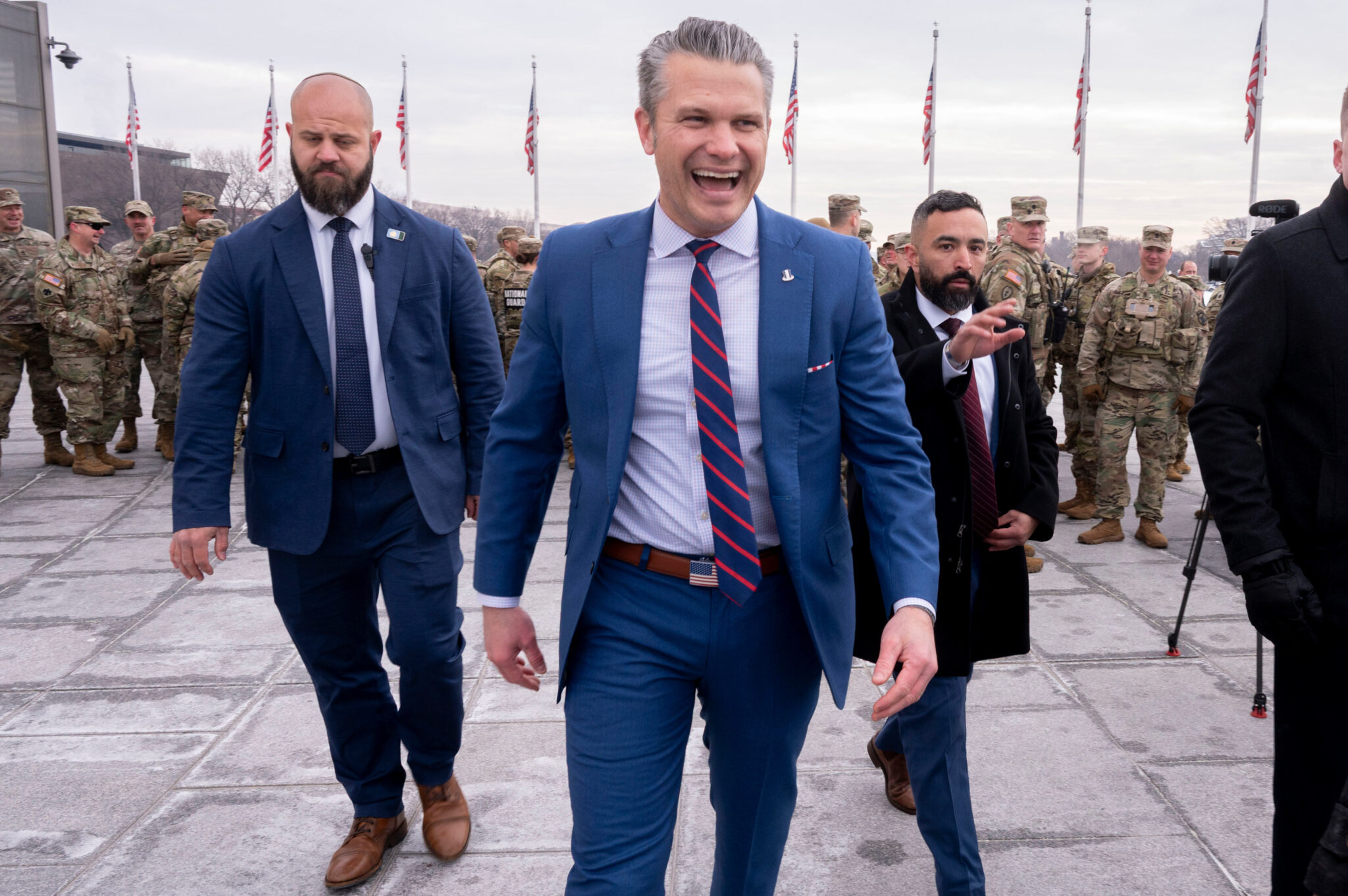
Hegseth Meets Anthropic CEO Amodei Amid Military AI Debate/ Newslooks/ WASHINGTON/ J. Mansour/ Morning Edition/ Defense Secretary Pete Hegseth is set to meet Anthropic CEO Dario Amodei as tensions grow over the military’s use of artificial intelligence. Anthropic remains the only major AI firm not fully supplying technology to a new Pentagon internal network. The meeting highlights broader disputes over autonomous weapons, surveillance risks, and ideological limits on AI deployment.



Hegseth Meets Anthropic CEO Amid Military AI Debate – Quick Looks
- Pete Hegseth to meet Anthropic CEO Dario Amodei
- Anthropic cautious about military AI applications
- Pentagon awarded AI contracts up to $200 million each
- Google, OpenAI, and xAI participating in GenAI.mil
- Debate centers on autonomous weapons and surveillance
- Anthropic approved for classified networks
- Trump administration pushes “non-woke” AI systems
Deep Look: Hegseth Meets Anthropic CEO Amodei Amid Military AI Debate


U.S. Defense Secretary Pete Hegseth is scheduled to meet Tuesday with Dario Amodei, chief executive of artificial intelligence firm Anthropic, as the Pentagon’s expanding use of AI faces growing scrutiny.
The meeting comes at a pivotal moment in the debate over how far military applications of AI should go — particularly in areas involving autonomous weapons, battlefield decision-making, and surveillance capabilities.
Anthropic, creator of the chatbot Claude, has positioned itself as one of the more safety-focused companies in the AI sector. While the company secured approval to operate within classified military networks, it has not fully integrated its technology into the Pentagon’s broader internal AI platform, GenAI.mil — unlike some of its competitors.
Pentagon’s Expanding AI Strategy
Last summer, the United States Department of Defense awarded defense contracts worth up to $200 million each to four leading AI companies: Anthropic, Google, OpenAI, and xAI.
Anthropic was the first among them approved for use on classified networks, working alongside defense data firm Palantir Technologies. However, Google and xAI have been more prominently featured in recent Pentagon AI announcements.
In January, Hegseth revealed that xAI’s chatbot Grok would join the GenAI.mil system. Shortly afterward, OpenAI announced that a customized version of ChatGPT would be made available to service members for unclassified tasks.
Hegseth has framed his AI vision in ideological terms, stating that military systems should function “without ideological constraints that limit lawful military applications.” He has repeatedly declared that the Pentagon’s AI “will not be woke,” reflecting broader culture-war rhetoric shaping parts of the administration’s defense strategy.
Ethical Concerns Over Autonomous Systems
Anthropic’s CEO has publicly warned about what he sees as the potential dangers of unchecked AI deployment. In a recent essay, Amodei cautioned against the risks of fully autonomous armed drones and the possibility of AI-driven mass surveillance systems capable of identifying and suppressing dissent.
“A powerful AI looking across billions of conversations from millions of people could gauge public sentiment, detect pockets of disloyalty forming, and stamp them out before they grow,” he wrote.
Amodei has rejected the label of “AI doomer,” but he argues that risks in 2026 are significantly greater than just a few years ago. He advocates pragmatic guardrails, transparency, and oversight mechanisms to prevent catastrophic misuse.
Political Friction With the Trump Administration
Anthropic’s safety-first stance has occasionally placed it at odds with President Donald Trump’s administration.
The company publicly criticized proposals to loosen export controls on advanced AI chips to China, sparring indirectly with chipmaker Nvidia while still maintaining commercial ties. It has also engaged in lobbying debates over state-level AI regulations, prompting criticism from Trump’s AI adviser David Sacks, who accused the company of promoting excessive regulation.
Despite these tensions, Anthropic has sought bipartisan credibility. It added Chris Liddell, a former Trump administration official, to its board, while also hiring former Biden administration staffers.
High-Stakes Military Applications
The Pentagon’s push to integrate AI mirrors earlier controversies such as Project Maven — a drone surveillance initiative that sparked internal protests among tech workers years ago. Although Google eventually withdrew from Maven, the Defense Department’s use of AI-driven surveillance has expanded significantly.
Today’s AI debate goes beyond back-office efficiencies or logistics automation. Analysts say battlefield deployments — particularly systems that could influence lethal force decisions or nuclear command-and-control structures — represent far higher stakes.
Owen Daniels of Georgetown University’s Center for Security and Emerging Technology notes that while AI in administrative functions poses lower risks, operational deployments introduce complex ethical and strategic dilemmas.
“Military users are aware of these risks and have been thinking about mitigation for almost a decade,” Daniels has said, emphasizing that safeguards and human oversight remain central to responsible use.
What the Meeting Signals
Tuesday’s meeting between Hegseth and Amodei is expected to clarify whether Anthropic will deepen its collaboration with the Pentagon or maintain stricter limitations on how its AI tools are used.
For the Defense Department, AI is seen as essential to maintaining technological superiority against rivals like China and Russia. For Anthropic, the challenge lies in balancing national security cooperation with its commitment to safety and governance.
The outcome could shape how AI companies engage with military clients in the years ahead — and define how the United States navigates the intersection of innovation, warfare, and civil liberties.