Trump New Order Could Detain Thousands of Refugees/ Newslooks/ WASHINGTON/ J. Mansour/ Morning Edition/ A new Trump administration directive could require thousands of legal refugees to return to federal custody. The Department of Homeland Security says refugees seeking green cards may be detained after one year. Advocacy groups and lawmakers warn the policy could trigger mass arrests and legal challenges.

Trump Order Could Detain Thousands of Refugees Quick Looks
- DHS memo filed ahead of Minnesota court hearing
- Refugees applying for green cards may face detention
- Policy could impact nearly 200,000 recent arrivals
- Operation PARRIS reexamines refugee cases
- Federal judge weighing extension of temporary block
- Immigration advocates warn of fear and confusion
- Minnesota lawmakers criticize new enforcement effort
- Legal challenges expected nationwide

Deep Look: Trump New Order Could Detain Thousands of Refugees
The administration of Donald Trump has unveiled a sweeping immigration directive that could place tens of thousands of legally admitted refugees back into federal custody, marking one of the most aggressive refugee enforcement shifts in recent years.
According to a memo submitted by the Department of Homeland Security (DHS) ahead of a federal court hearing in Minnesota, refugees who have been in the United States for one year and are applying for lawful permanent residency — commonly known as a green card — may be required to return to federal custody while their cases undergo review. The memo states that DHS “may maintain custody for the duration of the inspection and examination process,” raising the possibility of prolonged detention.
The directive could affect a significant portion of the nearly 200,000 refugees admitted during the administration of Joe Biden, many of whom have not yet secured permanent residency status.
The announcement came just hours before U.S. District Judge John Tunheim heard arguments in Minneapolis over whether to extend a temporary restraining order that currently protects certain refugees in Minnesota from arrest and deportation. Though Tunheim’s order applies only within Minnesota, the broader national implications of the DHS memo were central to the courtroom debate.
Justice Department attorney Brantley Mayers argued that the federal government retains discretion to detain refugees after their first year in the country. However, he indicated that detention would not necessarily occur in every case, describing it as a judgment call for DHS officials. Attorneys representing Minnesota refugees questioned that assurance, expressing concern that the new directive effectively mandates detention in most circumstances.
Judge Tunheim did not immediately issue a ruling but said he would release a written decision soon. His temporary order, issued Jan. 28, is set to expire unless replaced by a more durable preliminary injunction.
In earlier findings, Tunheim rejected the administration’s assertion that it automatically has the authority to detain refugees who have not obtained green cards within a year. Refugees are required to wait at least one year after admission before applying for permanent residency — a requirement the judge described as incompatible with a mandatory detention policy. He warned that such an interpretation could result in widespread arrests unless immigration reviews occurred precisely at the one-year mark, which he called “nonsensical.”
The new policy builds on Operation PARRIS — short for Post-Admission Refugee Reverification and Integrity Strengthening — a federal enforcement initiative launched in Minnesota. The program reexamined approximately 5,600 refugees in the state who had not yet been granted green cards. Federal officials cited alleged public benefits fraud as part of the rationale for the operation.
Operation PARRIS formed part of a broader immigration enforcement surge in Minnesota that included thousands of federal officers. The initiative drew national attention after federal agents fatally shot two U.S. citizens during enforcement operations, sparking protests and political backlash. While border czar Tom Homan later announced the large-scale surge was ending, a smaller federal presence remains.
Advocacy groups have strongly criticized the latest directive. HIAS, a nonprofit organization that supports refugees and asylum seekers, described the order as a move that could detain and potentially deport individuals who were legally admitted and vetted by the U.S. government.
Refugees admitted to the United States undergo extensive screening by multiple federal agencies before resettlement. Judge Tunheim noted in prior rulings that those detained under Operation PARRIS had not been charged with deportable crimes, nor were they deemed public safety threats or flight risks.
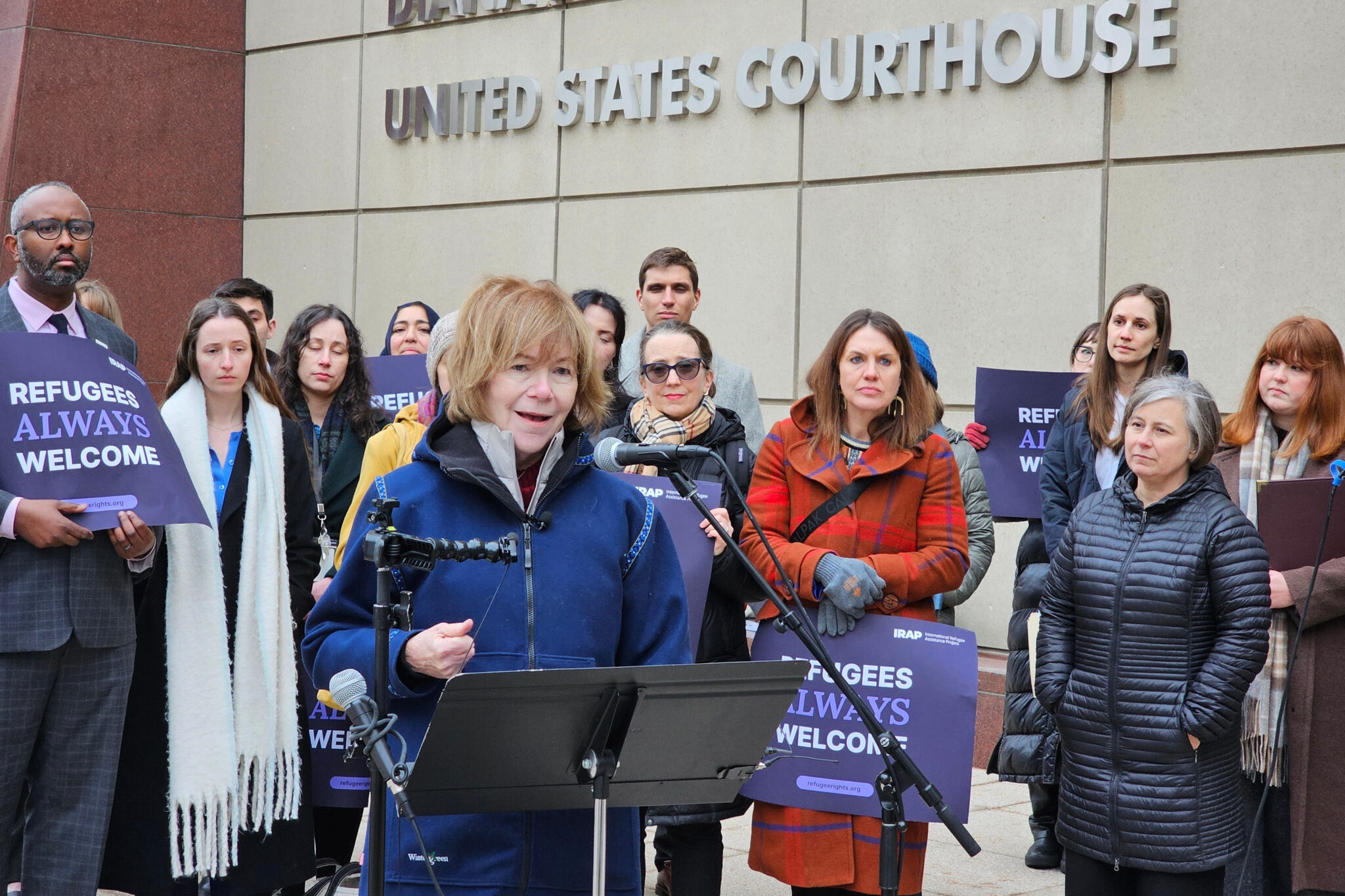
Minnesota Democratic Sen. Tina Smith criticized the administration’s legal arguments outside the courthouse, saying officials had failed to provide a coherent legal justification for the new policy. She pledged continued legal opposition alongside refugee rights groups and local leaders.
The administration has defended its actions by citing national security and economic concerns, arguing that stricter oversight of refugee cases is necessary. A previously obtained memo indicated that officials were reviewing refugees admitted during the prior administration and had already suspended green card approvals for some applicants.
If implemented broadly, the directive could create widespread uncertainty among refugee communities nationwide. Legal experts anticipate immediate constitutional and statutory challenges, particularly regarding due process protections and longstanding refugee resettlement frameworks.
Immigration law specialists also note that refugees differ from other immigrant groups because they are granted lawful status upon entry due to documented persecution in their home countries. They have authorization to work and reside legally in the United States while pursuing permanent residency.
As the Minnesota court weighs whether to extend protections locally, the policy’s national impact remains unclear. How DHS exercises its detention discretion — and whether courts ultimately block or uphold the order — could shape refugee enforcement policy for years to come.
For now, refugee communities, advocacy organizations, and legal observers are bracing for what could become one of the most consequential immigration battles of Trump’s current term.