Trump Orders Oil Tanker Blockade Targeting Venezuela’s Economy/ Newslooks/ WASHINGTON/ J. Mansour/ Morning Edition/ President Trump has ordered a naval blockade of sanctioned oil tankers heading to Venezuela, intensifying pressure on Nicolás Maduro’s regime. The move follows the seizure of a tanker and increases military presence near Venezuela. Critics call it a violation of international law, while Trump claims the country owes the U.S. oil and assets.
Venezuela Oil Blockade Quick Looks
- Trump orders “total blockade” of sanctioned oil tankers to and from Venezuela.
- Action follows U.S. seizure of tanker and increased naval presence.
- Trump accuses Venezuela of funding crime and stealing U.S. assets.
- Maduro’s government calls move illegal and threatens UN action.
- U.S. military buildup includes aircraft carriers and patrol aircraft.
- Over 95 killed in 25 maritime strikes since campaign began.
- Trump’s chief of staff admits goal is to oust Maduro.
- Venezuela exports 850,000 barrels per day, mostly to China.
- PDVSA relies on black-market routes due to U.S. sanctions.
- Trump claims Maduro offered oil stakes to avoid conflict.
Deep Look
Trump Orders Blockade on Venezuela’s Oil Tankers, Escalates Pressure on Maduro
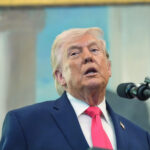
President Donald Trump announced Tuesday evening that he is ordering a full naval blockade of sanctioned oil tankers heading into or out of Venezuela, further escalating U.S. pressure on Venezuelan leader Nicolás Maduro. The bold move, announced via Trump’s social media platform, follows an earlier military buildup in the Caribbean and a U.S. seizure of a Venezuela-linked oil tanker last week.
In his post, Trump claimed Venezuela is using its oil industry to finance criminal activity, including drug trafficking, and demanded the return of what he described as U.S. property—oil, land, and assets allegedly “stolen” by the Maduro regime. He pledged to continue military escalation until those demands are met.
“Venezuela is completely surrounded by the largest Armada ever assembled in the History of South America,” Trump wrote. “It will only get bigger, and the shock to them will be like nothing they have ever seen before — Until such time as they return to the United States of America all of the Oil, Land, and other Assets that they previously stole from us.”
The White House did not offer additional details, and Pentagon officials referred all inquiries to the administration.
In swift response, Venezuela’s government issued a statement condemning Trump’s announcement as a violation of international law and the principles of free trade and maritime navigation. The Maduro regime accused Trump of treating Venezuela’s natural resources as U.S. property and vowed to bring the matter before the United Nations.
“The President of the United States intends to impose, in an utterly irrational manner, a supposed naval blockade on Venezuela with the aim of stealing the wealth that belongs to our nation,” the statement read.
The blockade comes amid an aggressive U.S. maritime campaign in the Caribbean and eastern Pacific, which has involved targeted strikes on vessels suspected of smuggling drugs or defying sanctions. According to U.S. military data, at least 95 people have died in 25 such strikes, a number that has raised concerns among lawmakers from both parties.
Trump has hinted that his administration is ready to expand the campaign beyond maritime enforcement. His team has already suggested a transition to land-based operations.
Although the administration officially frames the military activity as part of its anti-narcotics efforts, a recent interview with Trump’s chief of staff Susie Wiles confirmed broader ambitions. Wiles told Vanity Fair that the campaign’s true aim is to force Maduro from power.
“Trump wants to keep on blowing boats up until Maduro cries uncle,” Wiles said.
Venezuela, home to the world’s largest known oil reserves, remains heavily dependent on petroleum exports for economic survival. Under Trump-era sanctions reimposed in 2017, the country’s state oil firm PDVSA has been shut out of global markets. As a result, Venezuela has turned to a shadow network of unflagged tankers to move its oil—largely through China and Cuba.
According to energy expert Francisco Monaldi of Rice University, Venezuela currently produces around 1 million barrels per day. Of that, roughly 850,000 barrels are exported—80% to China, 15-17% through U.S.-based Chevron under special licenses, and the remainder to Cuba.
Despite these export channels, the government remains under financial strain. Trump claimed in October that Maduro had privately offered stakes in Venezuela’s oil and minerals to the U.S. as a way to ease tensions.
“He’s offered everything,” Trump said. “You know why? Because he doesn’t want to f—- around with the United States.”
While the administration announced a “TOTAL AND COMPLETE BLOCKADE OF ALL SANCTIONED OIL TANKERS,” the exact enforcement mechanism remains unclear.
The U.S. Navy currently maintains a significant presence in the region, including an aircraft carrier, amphibious ships, and maritime patrol aircraft like the P-8 Poseidon. These assets allow the U.S. to monitor and potentially intercept marine traffic heading to or from Venezuelan ports.
Trump’s announcement also referred to the “Venezuelan Regime” being designated a “FOREIGN TERRORIST ORGANIZATION,” a term typically reserved for non-state groups. The Venezuelan government is not on the State Department’s list of state sponsors of terrorism. However, the administration previously designated the “Cartel de los Soles”—a network of Venezuelan military officials involved in drug trafficking—as a terrorist group. Legal experts question the appropriateness and implications of applying such a label to a sovereign state.
Venezuela is now preparing to launch a formal complaint at the United Nations, while also signaling its intent to rally international support against the blockade.
In the meantime, critics of Trump’s move argue that the escalation risks unintended consequences, both diplomatically and militarily. They also warn that the blockade could further restrict humanitarian aid and worsen conditions for ordinary Venezuelans already suffering from economic collapse.
Despite mounting concerns, the Trump administration remains committed to a strategy of maximum pressure. Whether this approach will force political change in Venezuela—or lead to deeper conflict—remains to be seen.