Gulf Allies Complain US Didn’t Notify Them of Iran Attacks, Ignored Their Warnings/ Newslooks/ WASHINGTON/ J. Mansour/ Morning Edition/ Persian Gulf allies are expressing frustration with the United States over its handling of the war with Iran. Officials say Washington failed to warn them ahead of the initial strikes and did not adequately defend them against Iranian retaliation. The tensions highlight growing concerns among Gulf nations about security risks and regional instability.
US Iran War Gulf Allies Frustration Quick Looks
- Gulf officials say the U.S. did not warn them ahead of strikes on Iran.
- Iranian retaliation included hundreds of drones and missiles targeting Gulf states.
- Regional allies say their air defense systems and interceptor supplies are rapidly declining.
- Critics argue U.S. defenses prioritized protecting Israel and American troops.
- Pentagon officials reportedly acknowledged difficulty intercepting Iranian drone waves.
- Iranian strikes have killed at least 13 people across Gulf countries.
- The conflict is raising fears of long-term instability across the Middle East.
Deep Look: Gulf Allies Complain US Didn’t Notify Them of Iran Attacks, Ignored Their Warnings
Frustration is mounting among U.S. allies in the Persian Gulf as they grapple with the fallout from escalating conflict between the United States, Israel, and Iran. Officials from several Gulf countries say they were not properly informed about the initial strikes on Iran and feel the United States has not done enough to protect them from the wave of retaliatory attacks that followed.
According to officials familiar with regional diplomacy, governments across the Gulf were caught off guard by the U.S.-Israeli military action against Iran on Feb. 28. Those strikes triggered a major Iranian response that has included hundreds of drones and missiles launched toward targets across the region.
Officials from two Gulf countries said their governments had warned Washington in advance that attacking Iran could have severe consequences for the entire region. Despite those warnings, they say the United States moved forward without giving Gulf allies enough notice to prepare for potential retaliation.
The officials spoke anonymously due to the sensitivity of diplomatic discussions. Their accounts reflect growing private frustration within governments that are key U.S. security partners in the Middle East.
Several Gulf nations—including Bahrain, Kuwait, Oman, Qatar, Saudi Arabia, and the United Arab Emirates—have so far avoided publicly criticizing Washington. However, none of those governments responded to requests for comment regarding the concerns raised by officials.
The Trump administration has defended its actions and emphasized its ongoing coordination with regional allies.
White House spokeswoman Anna Kelly said Iranian attacks across the region have declined significantly as a result of U.S. military operations targeting Iran’s missile and drone capabilities.
According to the administration, the operation—known as “Operation Epic Fury”—has reduced Iran’s ability to launch further attacks or manufacture additional weapons.
“President Trump is in close contact with all of our regional partners,” Kelly said, arguing that Iran’s strikes against neighboring countries demonstrate why the military action was necessary.
Despite those assurances, Gulf officials say the reality on the ground remains challenging. Iranian retaliation has placed their countries directly in the crosshairs of the conflict.
Since the start of the war, Iran has launched at least 380 missiles and more than 1,480 drones toward five Arab Gulf nations, according to an Associated Press tally based on official statements.
Those attacks have already resulted in casualties. Local authorities say at least 13 people have been killed across the region.
The conflict has also directly affected U.S. military personnel. Six American soldiers were killed in Kuwait when an Iranian drone strike struck an operations center located at a civilian port facility. The site was more than 10 miles from the main U.S. Army base in the country.
According to family members of one of the victims, the operations center consisted of a container-style building that lacked adequate defenses against incoming attacks.
Privately, Pentagon officials have acknowledged that defending against Iran’s drone tactics presents significant challenges.
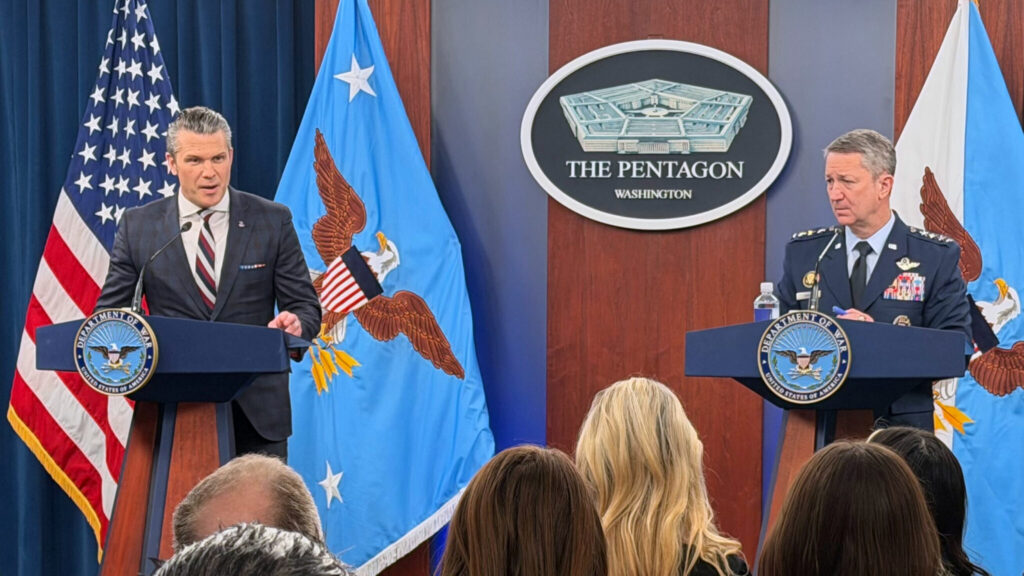
During classified briefings with members of Congress, Defense Secretary Pete Hegseth and Gen. Dan Caine, chairman of the Joint Chiefs of Staff, reportedly told lawmakers that intercepting large numbers of incoming drones may not be possible in many cases.
Three individuals familiar with those briefings said U.S. officials admitted they cannot reliably stop waves of unmanned aerial vehicles—especially Iranian Shahed drones.
Lawmakers also pressed military leaders on why American forces appeared unprepared for the scale of Iran’s response. According to one official familiar with the discussions, Pentagon leaders did not provide detailed explanations.
Another U.S. official said American air defense systems are not deployed widely enough throughout the Gulf to counter large-scale drone attacks outside traditional military bases in Iraq and Syria.
Iran’s geographic proximity to Gulf states gives it strategic advantages. Many of those countries lie within range of Iran’s short-range missile systems and host a range of potential targets, including energy infrastructure, tourism hubs, and American military facilities.
Drone strikes have already hit diplomatic locations as well. A drone attack this week sparked a small fire at the U.S. embassy compound in Riyadh, Saudi Arabia. Another strike caused minor damage outside the U.S. consulate in Dubai in the United Arab Emirates.
The scale of Iran’s drone campaign has even prompted unusual cooperation. Ukraine, which has extensive experience defending against Iranian-made Shahed drones during its war with Russia, has reportedly offered assistance.
Ukrainian President Volodymyr Zelenskyy said his government was willing to help provide expertise on countering the drone systems. When asked about the offer, President Trump said he would consider accepting support from any country able to help.
Regional analysts say the current situation exposes potential gaps in the planning surrounding the conflict.
Bader Mousa Al-Saif, a Kuwait-based analyst affiliated with the international policy institute Chatham House, said U.S. planners may have underestimated the risks facing Gulf allies.
American officials likely assumed Iran would concentrate its retaliation on Israel or on U.S. military bases rather than broader regional targets, he said.
“I don’t think they saw that there would be as much exposure to the Gulf,” Al-Saif said, describing the lack of a coordinated regional defense plan as short-sighted.
Some analysts also say Gulf governments may feel frustrated by the contrast between their defensive capabilities and Israel’s. Israel’s missile defense systems have intercepted a large percentage of incoming threats, while some Gulf states have struggled to keep pace with repeated drone waves.
Despite the attacks, Gulf governments have not launched direct retaliatory strikes against Iran.
Elliott Abrams, a former U.S. diplomat who served as special representative for Iran during Trump’s first administration, said regional leaders had long feared the possibility of Iranian retaliation but were uncertain whether Tehran would actually carry it out.
Now that it has, Abrams said, the conflict could deepen tensions across the Middle East.
“These attacks will leave long-term enmity,” Abrams said, warning that Gulf states could eventually retaliate if the strikes continue.
At the same time, Gulf countries face complex political and economic calculations.
Michael Ratney, a former U.S. ambassador to Saudi Arabia and now a senior adviser at the Center for Strategic and International Studies, said many Gulf governments want Iran’s military power reduced but remain worried about the broader consequences of the war.
The ongoing conflict threatens regional stability, economic growth, and energy markets that are critical to the global economy.
Ultimately, Ratney said, the countries closest to Iran may bear the greatest burden of whatever comes next.
“What happens next?” he asked. “The countries of the Gulf will have to bear the brunt of whatever that is.”