7.7 Magnitude Quake Raises Mega-Quake Fears in Japan/ Newslooks/ WASHINGTON/ J. Mansour/ Morning Edition/ A powerful 7.7-magnitude earthquake off northern Japan triggered a brief tsunami warning and raised concerns about a possible mega-quake. Authorities said the chance of a major quake has slightly increased and urged coastal residents to review emergency preparations. The tsunami threat later passed, and officials confirmed no major damage to nuclear facilities.
Japan Warns of Higher Mega-Quake Risk After 7.7 Quake Quick Looks
- A 7.7-magnitude earthquake struck off northern Japan on Monday
- A short-lived tsunami warning was issued and later lifted
- Officials raised the mega-quake risk from 0.1% to 1% for the next week
- Residents in 182 coastal towns were urged to increase preparedness
- Prime Minister Sanae Takaichi asked people to check shelters and emergency supplies
- More than 180,000 people were advised to evacuate temporarily
- Two people were injured after falling during the quake
- No problems were reported at nuclear power facilities

Deep Look
Powerful 7.7 Earthquake Triggers Tsunami Warning in Northern Japan
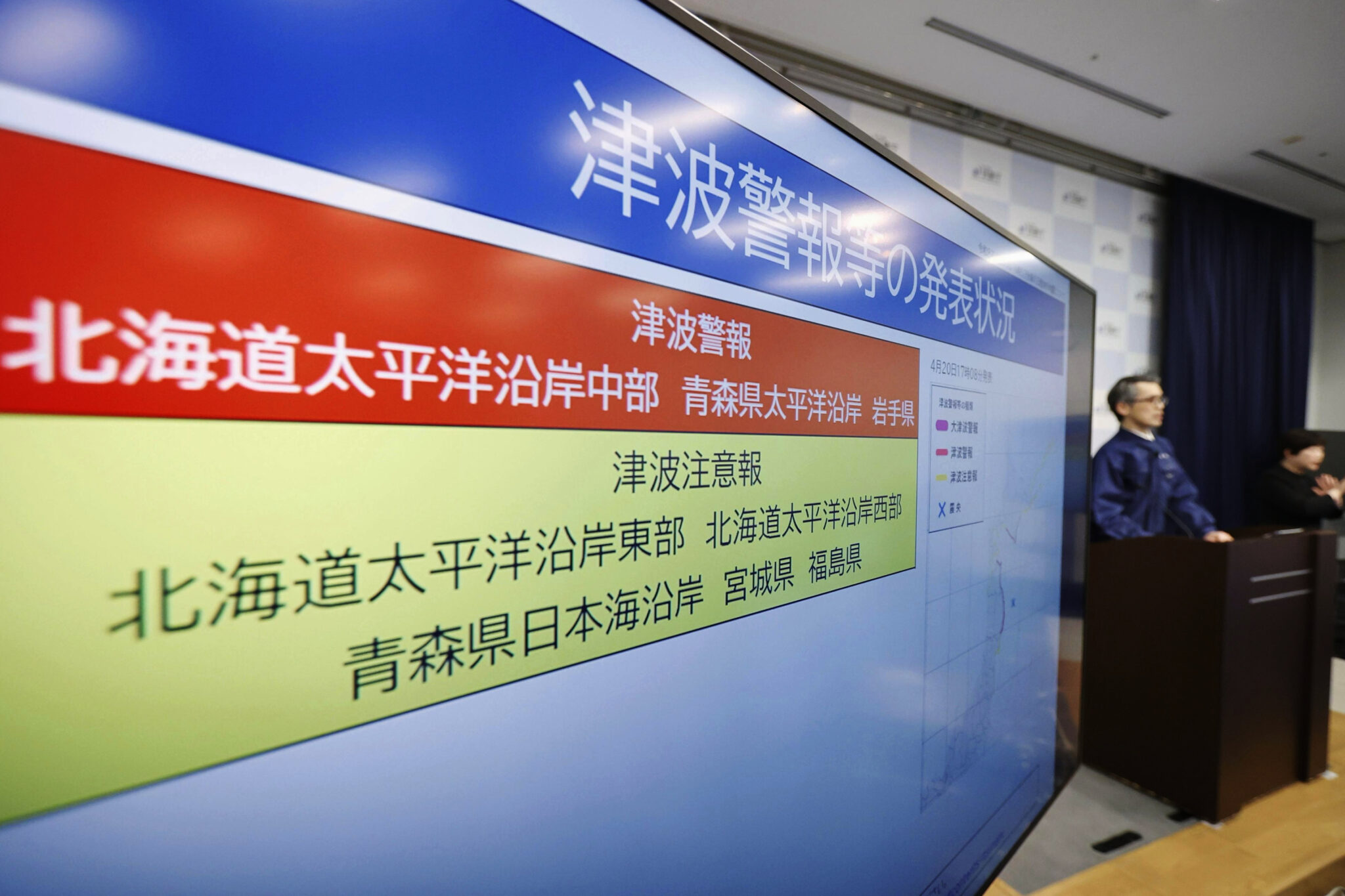
Japan issued a fresh mega-quake advisory Monday after a powerful 7.7-magnitude earthquake struck off the country’s northern coast, briefly triggering tsunami warnings and reviving memories of the devastating 2011 disaster.
The earthquake occurred near the Chishima and Japan trenches off the Sanriku coast at approximately 4:53 p.m. local time, according to the Japan Meteorological Agency.
Officials said the quake struck at a depth of around 19 kilometers (11 miles), causing strong shaking across northeastern Japan and prompting immediate tsunami alerts for coastal communities.
Authorities later lifted all tsunami advisories after determining the immediate danger had passed, but the government warned that the risk of a larger seismic event had slightly increased.
The earthquake served as another reminder of Japan’s vulnerability to major undersea earthquakes and tsunamis.
Mega-Quake Risk Raised but Not a Prediction
Japan’s Cabinet Office and the Japan Meteorological Agency said the probability of a mega-quake in the coming week had risen from the usual 0.1% to 1%.
While that remains a relatively low chance, officials emphasized that it represents a meaningful increase compared to normal conditions.
They stressed that the advisory should not be interpreted as a prediction that a major earthquake will happen.
Instead, it is meant to encourage residents to improve readiness while continuing normal daily life.
Officials specifically advised people in 182 towns along northeastern coastal areas to review evacuation plans, emergency supplies, and local shelter information.
This marked the second such advisory issued for the region in recent months.
A similar warning followed a 7.5-magnitude earthquake in December, though no mega-quake followed that event.
Prime Minister Urges Immediate Preparedness
Prime Minister Sanae Takaichi called on residents in affected areas to prepare now rather than wait for another warning.
Speaking to reporters, she urged families to confirm the locations of their designated shelters and evacuation routes.
She also asked residents to review emergency food supplies and ensure grab bags were ready so they could evacuate immediately if another large quake strikes.
“The government will do our utmost in case of an emergency,” she said.
Her comments reflected the government’s focus on public readiness, especially in regions still shaped by the trauma of past disasters.
Japan has one of the world’s most advanced earthquake warning systems, but officials repeatedly stress that personal preparation remains critical.
Tsunami Reached Coastal Ports Before Threat Passed
Following the quake, tsunami activity was recorded along parts of the northeastern coastline.
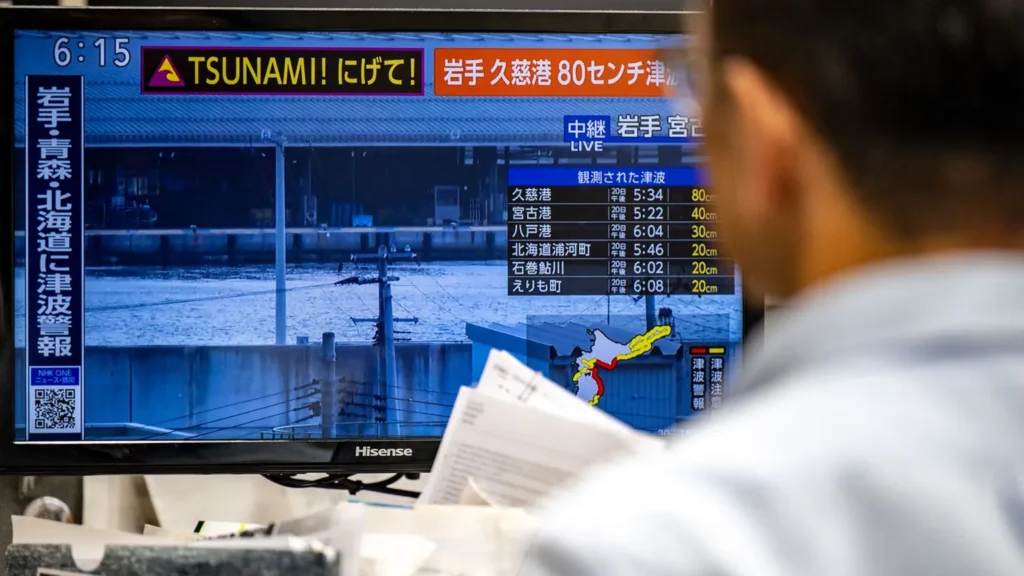
The Japan Meteorological Agency reported that a tsunami measuring about 80 centimeters (2.6 feet) reached Kuji port in Iwate prefecture within an hour of the earthquake.
Another smaller tsunami measuring 40 centimeters (1.3 feet) was also recorded at a nearby port in the same prefecture.
Public broadcaster NHK showed footage of hanging objects swaying inside buildings and people crouching inside a shopping center in Aomori as warnings were issued.
Authorities instructed residents to move to higher ground immediately and avoid coastal zones until the threat passed.
The U.S.-based Pacific Tsunami Warning Center later announced that the tsunami threat “has now passed.”
Japan also lifted all remaining tsunami warnings and advisories hours later.
Transportation Disrupted and Thousands Told to Evacuate
The earthquake temporarily disrupted major transportation networks across northern Japan.
Shinkansen bullet train services connecting Tokyo with northern regions were suspended for a time, leaving passengers waiting inside trains and on station platforms.
Emergency officials also issued evacuation advisories affecting more than 180,000 people across five prefectures, stretching from Hokkaido to Fukushima.
Residents were urged to move to safe shelters while authorities assessed tsunami risks and monitored for aftershocks.
The Fire and Disaster Management Agency later confirmed that two people were injured after falling during the quake—one in Aomori and one in Iwate.
No deaths were immediately reported.
Nuclear Facilities Show No Damage
One of the biggest concerns following major earthquakes in Japan remains the safety of nuclear facilities.
The Nuclear Regulation Authority said all nuclear plants and related facilities in the affected region were inspected and no abnormalities were found.
Officials confirmed that operations remained stable and no emergency response related to nuclear safety was needed.
This reassurance was especially important given the lasting public sensitivity surrounding nuclear safety after the Fukushima disaster.
The March 2011 earthquake and tsunami triggered one of the world’s worst nuclear crises when flooding caused meltdowns at the Fukushima Daiichi nuclear plant.
That disaster reshaped Japan’s energy policy and emergency preparedness systems.
Echoes of the 2011 Disaster Still Remain
Monday’s earthquake occurred almost exactly 15 years after the catastrophic March 11, 2011 earthquake and tsunami that devastated northeastern Japan.
That 9.0-magnitude quake killed more than 22,000 people and forced nearly half a million residents from their homes.
Most of the destruction came from the massive tsunami waves that followed the undersea quake, not the shaking itself.
Entire coastal communities were destroyed, and the disaster remains one of the defining national tragedies in modern Japanese history.
Because of that experience, even smaller tsunami warnings carry enormous emotional weight for residents in northern Japan.
Monday’s quake may not have caused catastrophic damage, but it served as a serious reminder that the threat of a mega-quake remains very real.