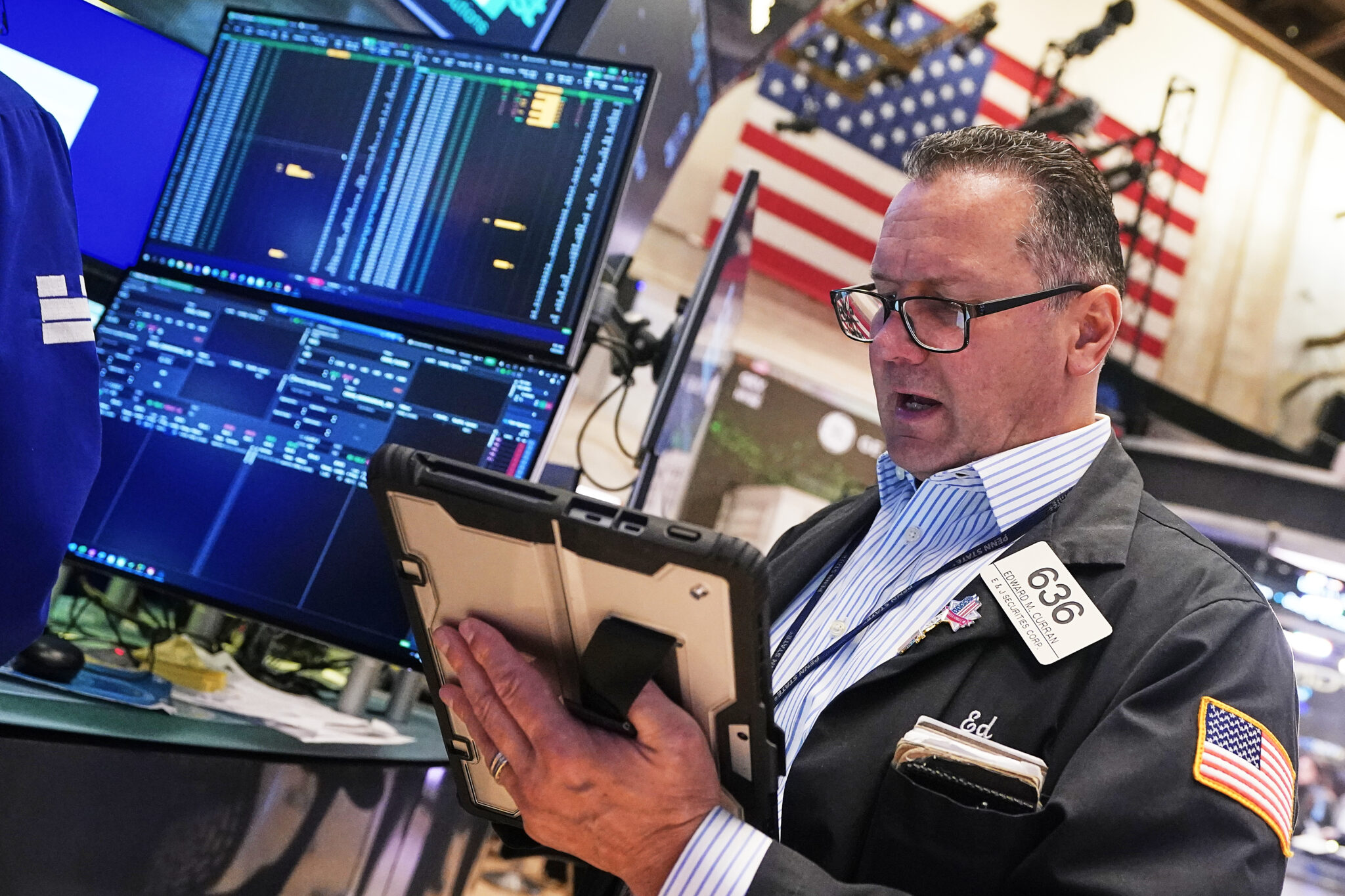
Wall Street Slips While Oil Prices Swing Higher/ Newslooks/ WASHINGTON/ J. Mansour/ Morning Edition/ U.S. stocks edged lower Thursday as mixed earnings from Tesla, IBM, and other major companies pulled Wall Street back from record highs. Oil prices moved higher as uncertainty over Iran and the Strait of Hormuz kept investors focused on global energy risks. Airline stocks reacted sharply to rising fuel costs, while investors also watched jobless claims and fresh economic growth data.

US Stocks and Oil Prices Quick Looks
- The S&P 500 slipped 0.1% after reaching record highs
- The Dow Jones Industrial Average fell 71 points
- The Nasdaq dropped 0.5% after setting its own record
- Tesla shares fell despite stronger-than-expected earnings
- Texas Instruments surged 16.6% after strong quarterly results
- Brent crude rose to $102.97 per barrel amid Iran tensions
- Airline stocks split as fuel costs and earnings shaped outlooks
Deep Look
Wall Street Pulls Back After Record Rally
NEW YORK — U.S. stocks moved slightly lower Thursday as investors stepped back from record highs and reacted to a mix of corporate earnings reports and rising concerns over global oil markets.
The S&P 500 slipped 0.1% after recently erasing all of its losses tied to the Iran war and climbing back to record territory.
The Dow Jones Industrial Average fell 71 points, also down 0.1%, while the Nasdaq composite dropped 0.5% after setting its own fresh high.
Markets remain caught between strong corporate performance and growing geopolitical uncertainty, especially around energy prices and Middle East tensions.
Investors are also closely watching inflation and Federal Reserve policy as rising oil prices threaten to create new economic pressure.
Tesla Shares Fall Despite Better Earnings
Tesla was one of the biggest drags on the market Thursday.
Its stock dropped 4.3% even though the electric vehicle giant reported better quarterly results than analysts had expected.
Investors appeared more focused on Tesla’s aggressive spending plans for the year ahead.
The company is preparing to invest heavily in factories for robotics and other future-focused products, raising concerns about near-term costs.
“You should expect to see a very significant increase in capital expenditures,” Elon Musk told investors late Wednesday, “but I think well justified for a substantially increased future revenue stream.”
The market reaction suggested some investors remain cautious about how quickly those future returns will materialize.
ServiceNow and IBM Also Pressure Tech Stocks
Software giant ServiceNow fell even harder, dropping 16.2% despite posting results that matched Wall Street expectations.
The broader software sector has been under pressure as investors worry that AI-powered competitors could weaken traditional business models.
Analysts also said investors may have been disappointed by the company’s forecast for slower growth in a key revenue area.
IBM also struggled, falling 9.7% even after reporting stronger profit and revenue than expected.
Analysts pointed to slowing growth trends inside its software business as a reason investors reacted negatively.
These results show how investors are becoming more selective, rewarding strong growth visibility rather than simply beating earnings estimates.
Texas Instruments Leads the Winners
Helping limit broader market losses was Texas Instruments, which delivered one of the strongest performances of the day.
Its shares jumped 16.6%, making it the single biggest positive force pushing the S&P 500 upward.
The semiconductor company easily beat analysts’ profit expectations and issued stronger-than-expected forecasts for both spring revenue and earnings.
CEO Haviv Ilan said the company continues benefiting from strong demand from industrial customers and major data centers tied to the artificial intelligence boom.
The strong results also reflected broader investor confidence in chipmakers connected to AI infrastructure growth.
Oil Prices Swing Higher on Iran Uncertainty
In energy markets, oil prices remained volatile as traders continued watching the dangerous situation in the Strait of Hormuz.
Although a ceasefire between the United States and Iran remains in place, oil tankers are still struggling to move through the narrow waterway off Iran’s coast.
That shipping disruption is creating serious concerns for global energy supplies.
The U.S. military added to tensions Thursday by seizing another tanker linked to Iranian oil smuggling, just one day after Iran’s Revolutionary Guards took control of two vessels in the same area.
President Donald Trump also escalated the situation by saying he had ordered the U.S. military to “shoot and kill” small Iranian boats deploying mines in the strait.
Brent crude, the international oil benchmark, rose 1% to $102.97 per barrel after swinging between roughly $101 and $106 overnight.
There is still no clear timeline for whether U.S.-Iran peace talks, previously hosted by Pakistan, will resume.
Airlines React Differently to Higher Fuel Costs
Rising oil prices are hitting airline stocks especially hard because fuel remains one of the industry’s largest expenses.
Still, airline shares moved in different directions Thursday depending on earnings performance.
American Airlines rose 4% after posting stronger-than-expected quarterly profit and revenue.
Despite winter storms hurting first-quarter operations, the airline said travel demand remained strong and reported the nine best weeks for revenue intake in its 100-year history.
Southwest Airlines moved the opposite way, falling 2.2% after weaker-than-expected quarterly results.
The company also said it would not provide an updated full-year profit forecast because of “the ongoing macroeconomic uncertainty.”
That cautious outlook reflects broader business concerns across multiple industries.
Global Markets and Treasury Yields
Outside the United States, stock markets were mostly lower across Europe and Asia.
Hong Kong’s Hang Seng index fell 0.9%, while Japan’s Nikkei 225 dropped 0.7%.
South Korea’s Kospi was a notable exception, rising 0.9% after stronger-than-expected economic growth data.
The country’s export strength, especially in AI-related semiconductor demand, helped support investor confidence.
Chip supplier SK Hynix also reported stronger-than-expected quarterly revenue driven by AI demand.
In the U.S. bond market, the 10-year Treasury yield edged slightly lower to 4.29% from 4.30% late Wednesday.
Economic Data Shows Stability with Some Caution
Fresh economic reports offered a mixed but mostly stable picture of the U.S. economy.
A Labor Department report showed slightly more Americans filed for unemployment benefits last week, though claims remain at historically healthy levels.
That suggests layoffs are still relatively low even as hiring slows.
Another early report from S&P Global indicated that U.S. business activity may be improving slightly after near-stagnation in March.
Together, the data points to an economy that remains resilient, but still vulnerable to inflation, high interest rates, and global conflict.
For investors, that means markets may continue moving cautiously — especially as oil prices and earnings reports remain in sharp focus.