


Republicans Tee Up Government Funding Bill Months Early to Avoid Election Season Shutdown/ Newslooks/ WASHINGTON/ J. Mansour/ House Republicans are moving unusually early on a stopgap bill that would fund the federal government through Dec. 4. GOP leaders want to remove the risk of a shutdown before the midterm elections and focus lawmakers on a separate $95 billion priority package. Democrats oppose the process, arguing that the measure was introduced without bipartisan negotiations and is being rushed months before the deadline.
Quick Look
- House Republicans planned a Tuesday vote on government funding.
- The legislation would keep federal agencies operating through Dec. 4.
- Current funding expires Sept. 30.
- Congress is acting more than two months before the deadline.
- Stopgap bills are usually passed shortly before funding expires.
- The House has only 16 scheduled legislative days after this week and before Sept. 30.
- Most agencies would continue operating at current spending levels.
- Democrats are expected to oppose the measure overwhelmingly.
- Speaker Mike Johnson said Democrats would own any shutdown if they reject the bill.
- Republicans want to focus on a separate $95 billion package.
- That proposal includes military funding, farmer aid and voting law changes.
- Rep. Rosa DeLauro said Democrats were excluded from negotiations.
- Republicans say the measure would avoid another lengthy shutdown.
- Conservative lawmakers support maintaining current spending temporarily.
- The bill’s future in the Senate is uncertain.
- At least some Democratic senators would need to support it.
Deep Look
Republicans Move Early on Government Funding
WASHINGTON — House Republicans are seeking to prevent a government shutdown during the fall election campaign by voting Tuesday on legislation that would fund federal agencies through Dec. 4.
The existing funding deadline is Sept. 30, more than two months away.
Congress ordinarily approves temporary spending measures only days—or sometimes hours—before a shutdown deadline.
Republican leaders are acting early because they do not want a funding crisis to influence voters ahead of the midterm elections.
Johnson Challenges Democrats
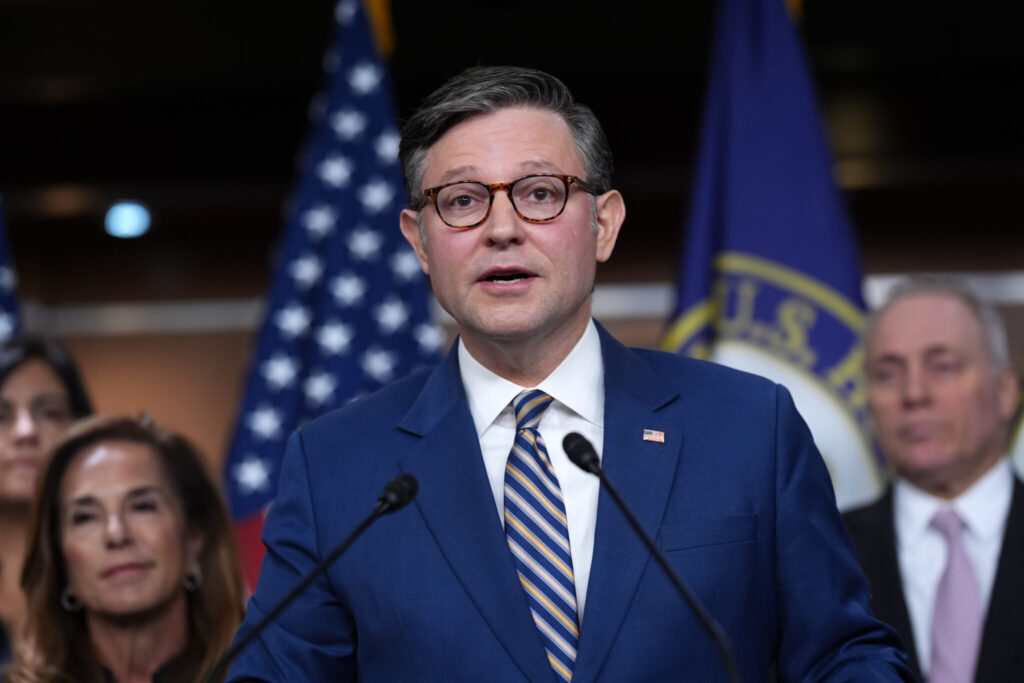
House Speaker Mike Johnson is urging Democrats to support the stopgap measure, commonly known as a continuing resolution.
Johnson warned that if Democrats vote against it, “then they alone are going to own the chaos that ensues if the government shuts down after September 30.”
Democrats are expected to oppose the legislation overwhelmingly.
The measure would generally maintain current funding levels rather than establish new spending priorities for the full fiscal year.
House Has Limited Time Before Deadline
The House is scheduled to leave Washington after this week.
Once lawmakers return, they will have only 16 scheduled legislative days before federal funding expires.
Republican leaders say the limited calendar creates a risk that Congress could fail to reach an agreement by Sept. 30.
Moving the continuing resolution now would eliminate that immediate deadline and keep agencies operating through the elections.
GOP Wants to Focus on $95 Billion Package
Republicans plan to devote much of their remaining legislative time to another White House priority.
The separate $95 billion package would provide additional defense funding, financial assistance for farmers and money for parts of Trump’s proposed election overhaul.
The election provisions are expected to include stricter voter identification requirements.
The bill faces difficult prospects and is expected to advance without Democratic support if Republicans can unite behind it.
Republican Says Move Is Politically Smart
Rep. Austin Scott of Georgia supported dealing with the shutdown threat in advance.
“I think it’s kind of smart to go ahead and take the potential chaos of a shutdown off the table because the amount of damage that does to the American citizens,” Scott said.
He argued that a shutdown “probably works to the advantage of Democrats politically.”
Scott blamed media coverage for contributing to that political dynamic.
Democrats Object to Process
Rep. Rosa DeLauro of Connecticut, the senior Democrat on the House Appropriations Committee, criticized how Republicans introduced the measure.
She said Democrats received the legislation Friday without any bipartisan negotiation.
Democrats would have sought several changes if they had participated in drafting the bill.
Those priorities include restrictions on a Trump administration rule allowing agency leaders to block or terminate grants they say are inconsistent with the president’s agenda.
DeLauro Says Congress Has Time
DeLauro argued that lawmakers should not approve an incomplete extension when more than two months remain before the fiscal year ends.
“We still have two months before the end of the fiscal year and should not rush through an incomplete funding extension,” she said.
“We ought to wait for the information that we need to get it right the first time.”
Democrats maintain that Congress should use the remaining time to negotiate a bipartisan agreement that addresses both parties’ priorities.
Annual Spending Work Will Continue
Republicans said congressional committees would continue working on the 12 annual appropriations bills.
Those measures fund federal departments and programs for the full fiscal year.
The stopgap bill would not replace that process.
Instead, it would give Congress until Dec. 4 to complete the annual legislation or approve another funding extension.
GOP Seeks to Avoid Third Shutdown
Republican leaders pointed to two major funding crises during the current Congress.
The country experienced the longest complete federal shutdown in its history, followed by the longest partial shutdown on record.
Rep. Tom Cole of Oklahoma, chairman of the House Appropriations Committee, said Congress should not risk another closure.
“We’ve seen that happen twice in this Congress already,” Cole said.
“I’m not willing to risk a third time if we can avoid that.”
Conservatives Support Static Spending
Some conservative Republican lawmakers support the temporary extension because it would keep spending approximately unchanged.
Rep. Eric Burlison of Missouri described the continuing resolution as “the best way to spend the least amount of money.”
“You keep spending levels static for at least a period of time,” Burlison said.
Fiscal conservatives often oppose temporary funding bills, but some appear willing to support this one because it avoids immediate spending increases.
Senate Passage Remains Uncertain
It is unclear whether the Senate will approve the House bill.
Spending legislation generally requires 60 votes to advance in the Senate.
Republicans therefore cannot pass the measure without at least some Democratic support.
Even if the bill clears the House, senators could seek changes that would require another vote in the lower chamber.
The disagreement over process and policy means an early House vote may not eliminate the shutdown risk entirely.






You must Register or Login to post a comment.