

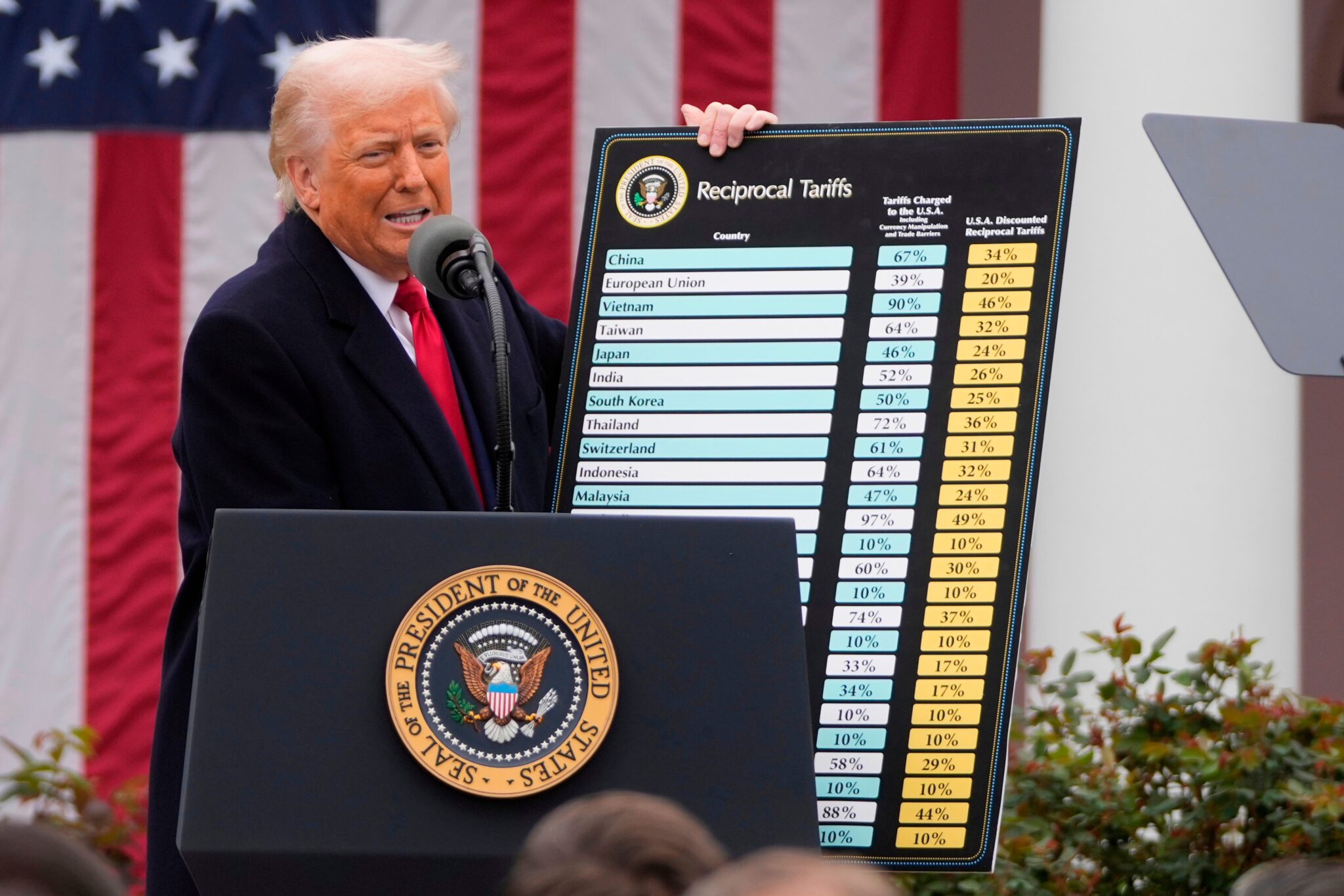
Trump Imposes 10% to 12.5% Tariffs on Imports From 60 Trading Partners/ Newslooks/ WASHINGTON/ J. Mansour/ President Donald Trump is imposing tariffs of 10% to 12.5% on imports from 60 trading partners, citing inadequate enforcement against products made with forced labor. The Section 301 tariffs take effect as Trump’s temporary 10% worldwide levies expire Friday following his Supreme Court defeat. Foreign governments and Democratic lawmakers challenged the justification, while labor-rights advocates said import restrictions could help if paired with enforcement and transparency.
Quick Look
- The United States will impose tariffs of 10% to 12.5%.
- The measures cover 60 trading partners representing 99% of U.S. imports.
- The tariffs are based on alleged failures to enforce bans on forced-labor goods.
- They replace temporary worldwide tariffs expiring at 12:01 a.m. Friday.
- The administration is using Section 301 of the Trade Act of 1974.
- The Supreme Court previously rejected Trump’s use of emergency powers for broad tariffs.
- Oil, natural gas and fertilizer are exempt.
- USMCA-qualified products will continue receiving duty-free treatment.
- India’s proposed rate was reduced from 12.5% to 10%.
- Brazil and Chile face tariffs of 12.5%.
- Brazil plans possible retaliation and a World Trade Organization complaint.
- U.S. importers pay tariffs and often pass the cost to consumers.
- The administration is investigating 16 countries over alleged overproduction.
- The International Labor Organization estimated 27.6 million people were in forced labor in 2021.
Deep Look
Trump Replaces Expiring Tariffs With New Levies
WASHINGTON — President Donald Trump is imposing double-digit tariffs on imports from dozens of American trading partners as his temporary worldwide levies expire Friday.
The new taxes range from 10% to 12.5% and apply to 60 trading partners that account for 99% of U.S. imports.
The administration says the countries failed to establish or effectively enforce bans on imported goods produced through forced labor.
“The United States has had a forced labor import ban for nearly a century, and rigorously enforces it; it’s well past time for our trading partners to do the same,” U.S. Trade Representative Jamieson Greer said.
New Tariffs Take Effect Friday
The measures will take effect as Trump’s temporary 10% tariffs on worldwide imports expire at 12:01 a.m. Friday.
Trump adopted the temporary levies after the Supreme Court invalidated the most expansive tariffs imposed during his second term.
The administration is now using Section 301 of the Trade Act of 1974, which allows trade sanctions against countries found to engage in “unjustifiable,” “unreasonable” or “discriminatory” practices.
Trump previously used Section 301 to impose major tariffs on China during his first term. Those measures survived legal challenges.
Supreme Court Rejected Emergency Tariffs
Trump dramatically changed decades of American trade policy in 2025 by imposing tariffs on imports from nearly every country.
He invoked the International Emergency Economic Powers Act of 1977 and argued that the country’s longstanding trade deficit constituted a national emergency.
The Supreme Court ruled in February that the emergency law did not authorize the president to impose tariffs.
That decision required the administration to refund importers that had paid the invalidated levies.
Temporary Authority Lasted Only 150 Days
Following the ruling, Trump imposed a 10% worldwide tariff under Section 122 of the Trade Act.
Section 122 allows a president to introduce temporary import restrictions for a maximum of 150 days.
That authority expires Friday, prompting the administration to replace the temporary duties with the more durable Section 301 tariffs.
More Tariffs Could Follow
The Office of the U.S. Trade Representative is conducting a separate investigation involving 16 countries that collectively account for 70% of American imports.
The inquiry is examining whether those countries overproduced certain goods, drove down global prices and placed U.S. companies at a competitive disadvantage.
The investigation has not been completed, but it could produce another round of tariffs.
Trump argues that higher import taxes will encourage companies to build factories and manufacture more products in the United States.
Some Countries Earned Lower Rates
The administration first proposed the forced-labor tariffs in June.
A senior administration official said several governments strengthened their enforcement policies during the review and consequently received lower rates.
India, for example, was initially expected to face a 12.5% tariff. Its final rate will be 10%, according to the official, who spoke anonymously because they were not authorized to discuss the matter publicly.
Energy, Fertilizer and USMCA Goods Exempt
Some goods will not be subject to the new tariffs.
Exemptions include oil, natural gas and fertilizer.
Products that meet duty-free requirements under the United States-Mexico-Canada Agreement will also be spared.
Trump negotiated the USMCA during his first term as a replacement for the North American Free Trade Agreement.
Democrat Questions Forced Labor Justification
Rep. Richard Neal of Massachusetts, the senior Democrat on the House Ways and Means Committee, said the administration was using a serious human-rights issue to justify a broader tariff policy.
“Today’s forced labor justification is too convenient to be taken seriously,” Neal said.
“Forced labor is a real and pervasive problem in our supply chains and demands serious enforcement. It should never be cheapened into a pretext for a tariff policy built on dubious legal theories and personal grievances.”
Brazil Plans Retaliatory Response
Brazil, which faces a 12.5% tariff, described the American action as “arbitrary and unjustified.”
Its government said it would activate a reciprocity law that could lead to retaliatory tariffs against the United States. Brazil also plans to file a complaint with the World Trade Organization.
The United States “chose to manipulate an issue of great importance to human rights and the struggles of workers worldwide in order to accuse 59 countries and the European Union of unfair practices,” the Brazilian government said.
Chile Rejects US Assessment
Chile will also face a 12.5% tariff.
Undersecretary for International Economic Relations Paula Estévez said Chile has “solid labor institutions, a robust regulatory framework and a firm commitment to the prevention and eradication of forced labor.”
“The Government of Chile considers that the application of this measure to our country is inconsistent with these standards, as well as with the technical, political, and legal background presented throughout the investigation process,” Estévez said.
Importers and Consumers Bear the Cost
Tariffs are collected from American companies that import foreign products.
Importers can absorb the cost, reduce orders or pass the expense to businesses and consumers through higher prices.
The administration is therefore taking an economic and political risk by introducing new levies before the Nov. 3 midterm elections.
Americans already dissatisfied with the cost of living could face higher prices on affected imported goods.
What Forced Labor Means
The International Labor Organization’s Forced Labour Convention defines forced labor as “all work or service which is exacted from any person under the menace of any penalty and for which the said person has not offered himself (or herself) voluntarily.”
The ILO estimated that approximately 27.6 million people worldwide were engaged in forced labor on any given day in 2021.
The tariffs apply to countries that the United States determined had either failed to ban forced-labor imports or failed to enforce existing prohibitions adequately.
Advocates See Potential but Question Approach
Martina Vandenberg, founder and president of The Human Trafficking Legal Center, said import bans can be useful even though they cannot eliminate forced labor on their own.
“We’ve gone on record for years now advocating for import bans, not as a magic bullet, it’s not a silver bullet, but as a potentially effective tool in combating forced labor across the globe,” Vandenberg said.
“It’s possible to be extremely critical of tariffs, as we are, and to be very concerned about blanket tariffs used as bludgeons against countries,” she added. “And yet I think it’s undeniable that there is a significant response in terms of the adoption of import bans.”
Groups Seek a Phased Implementation
Vandenberg’s organization urged the administration to introduce the tariffs gradually so governments have time to create enforcement systems.
“Our concern is that the import bans will be thin slips of paper with no enforcement,” she said. “Countries need time to build import ban mechanisms that are meaningful and enforceable.”
Human-rights advocates have also requested clearer information about how the administration evaluated each country.
Canada Calls Tariffs Expected
Canada-U.S. Trade Minister Dominic LeBlanc said the announcement “is not unexpected.”
He said Canada shares Washington’s goal of preventing products made with forced labor from entering international supply chains.
“We will continue engaging constructively with the United States on this matter, as well as other outstanding issues, over the coming weeks to the mutual benefit of our citizens,” LeBlanc said.
US Law Has Drawn Attention to Forced Labor
Kenya Davis, a partner at Boies Schiller Flexner, cited the Uyghur Forced Labor Prevention Act as the most significant recent American legislation addressing the issue.
The 2021 law generally prohibits imports made wholly or partly in China’s Xinjiang region or by entities linked to forced labor.
“The level of effectiveness is certainly up for debate, but it certainly has drawn attention to the issue of labor trafficking and forced labor,” Davis said. “And so, if nothing else, these import bans will serve that function of bringing greater awareness to forced labor.”
Davis said she remained “very cautious in my enthusiasm about the (tariffs)” without transparency, enforcement assistance and a broader strategy.
Tariff Threat Already Producing Changes
Isabelle Glimcher of the NYU Stern Center for Human Rights said one weakness is that the tariffs focus on countries’ import policies rather than goods those countries produce domestically.
However, she said the threat of Section 301 action appears to have influenced some governments.
India amended its foreign-trade policies to include a forced-labor import ban. European Union regulations addressing forced-labor goods are scheduled to take effect in 2027.
“Not all of these things are necessarily or wholly attributable to the Section 301 investigations, but does seem like countries are responding and starting to take all of this seriously,” Glimcher said.





You must Register or Login to post a comment.