

Trump Administration Announces $17.5 Billion for 10 New Nuclear Reactors/ Newslooks/ WASHINGTOn/ J. Mansour/ Morning Edition/ The Trump administration unveiled a $17.5 billion financing initiative to accelerate construction of 10 large nuclear reactors across the United States. Officials say growing electricity demand from AI-powered data centers is driving the need for expanded nuclear generation. The reactors are expected to begin construction by 2030 and start producing power in the mid-2030s.
Nuclear Reactor Expansion Quick Looks
- Energy Department announced $17.5 billion in federal loans.
- Plan supports construction of 10 new large nuclear reactors.
- Projects will use Westinghouse’s AP1000 reactor design.
- Five sites will be selected, each hosting two reactors.
- Construction could begin by 2030.
- Reactors are expected to be operational in the mid-2030s.
- Growing AI data center demand is fueling electricity needs.
- Federal loans aim to reduce costs and speed development.
- Utilities and Westinghouse are expected to contribute up to $5 billion in equity.
- Trump has set a goal of quadrupling U.S. nuclear power production within 25 years.
Deep Look
Trump Administration Launches Major Nuclear Energy Investment
The Trump administration announced Tuesday that it will provide $17.5 billion in federal financing to accelerate the development of 10 new large-scale nuclear reactors, marking one of the most ambitious nuclear energy initiatives in decades.
The funding effort is designed to help meet rapidly increasing electricity demand, particularly from artificial intelligence infrastructure and large-scale data centers that require enormous amounts of power.
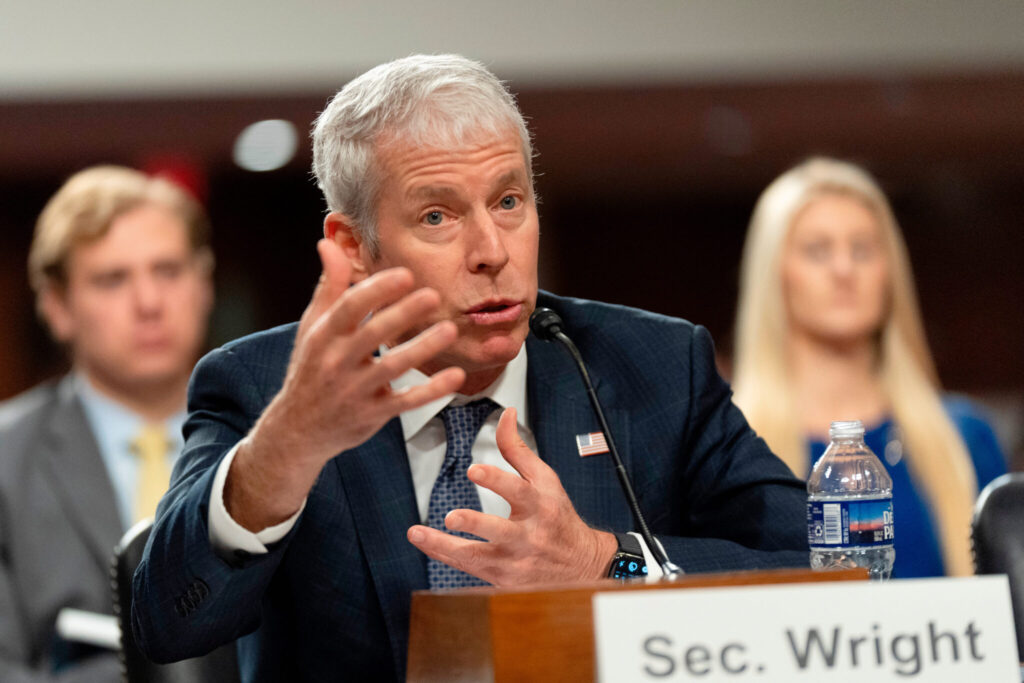
Energy Secretary Chris Wright said demand from data center developers, utilities and energy companies has created strong momentum for expanding nuclear generation across the country.
“This is the start,” Wright said on a call with reporters. “We’re going to move with the players that are ready to stand up and move quickly. Once that supply chain is up and running, do we think there will be dozens of these built going forward? I’d be very surprised if there were not.”
AI Boom Driving Electricity Demand
The administration cited the explosive growth of artificial intelligence and cloud computing as a key factor behind the push for additional nuclear power generation.
Government estimates indicate that data centers consumed between 4% and 5% of all U.S. electricity in 2024. That share could nearly triple by 2028 as AI technologies continue expanding.
Analysts also project overall U.S. electricity demand could increase by as much as 20% over the next decade, largely due to data center growth.
Nuclear energy is increasingly being viewed by policymakers and industry leaders as a reliable source of around-the-clock electricity capable of supporting the energy-intensive demands of AI development.
New Reactors to Use Proven AP1000 Design
The 10 planned reactors will use the AP1000 design developed by Westinghouse, one of the world’s leading nuclear technology companies.
The AP1000 is the same reactor design used at Georgia Power’s Plant Vogtle, where the only two large nuclear reactors built from scratch in the United States in recent decades were completed.
While the Vogtle project faced years of delays and billions of dollars in cost overruns, administration officials say lessons learned from that experience will help improve future projects.
Wright argued that Vogtle’s challenges were caused primarily by poor planning, supply chain disruptions and complications related to the COVID-19 pandemic rather than flaws in the reactor technology itself.
“But, he said, the reactor design is ‘robust and sound.’”
He added: “By building in volume and at multiple locations, we think we will create and stand up a large supply chain and build a lot of construction expertise.”
“We expect the timing and cost of these plants to well outperform what was done on Vogtle.”
Five Sites to Host Ten Reactors
According to the Energy Department, seven utilities and energy companies have already signed letters of intent identifying potential reactor locations.
Federal officials plan to select five sites, with each location hosting two AP1000 reactors.
The department has not publicly identified the participating utilities or the states under consideration, saying the process remains ongoing.
Officials also declined to provide a specific timeline for selecting the final sites.
The federal financing package will not directly cover construction expenses. Instead, the loans will be used to secure critical long-lead nuclear components that often create bottlenecks in major infrastructure projects.
Federal Loans Aim to Reduce Costs and Delays
The Energy Department estimates that providing early financing could accelerate reactor development by as much as three years while also helping lower overall construction costs.
Under the proposal, utilities and Westinghouse are expected to contribute up to $5 billion in private equity across the projects.
The federal government would provide up to $17.5 billion in debt financing, equivalent to roughly $3.5 billion for each two-reactor project.
Wright emphasized that the structure is designed to protect taxpayers while helping launch a domestic nuclear construction pipeline.
He described the financing approach as “very, very low risk to the American taxpayers.”
The administration’s goal is to have all 10 reactors under construction by 2030 and generating electricity by the middle of the next decade.
Trump Pushes Nuclear Energy Revival
The announcement aligns with President Donald Trump’s broader strategy to significantly expand U.S. nuclear energy production.
Trump has established a target of quadrupling domestic nuclear power output over the next 25 years and has signed multiple executive orders aimed at streamlining approvals and accelerating project development.
Beyond large reactors, the administration is also promoting emerging technologies such as small modular reactors (SMRs), which supporters argue can be built faster and at lower cost.
The White House sees nuclear power as a critical component of future economic growth, particularly in sectors such as artificial intelligence, advanced manufacturing and national security.
Industry Sees Opportunity for American Leadership
Westinghouse executives welcomed the announcement, arguing that large-scale nuclear deployment is necessary for the United States to remain globally competitive.
Dan Sumner, president and chief executive officer of Westinghouse, said nuclear expansion is essential to support the industries expected to shape the future economy.
He argued that building reactors at scale would strengthen America’s position in artificial intelligence, advanced manufacturing and other emerging sectors.
Industry advocates also say a larger domestic nuclear supply chain would create jobs, increase energy security and reduce dependence on foreign energy sources.
Critics Question Costs and Risks
Despite growing support for nuclear energy, critics continue to raise concerns about cost, construction timelines and safety.
Opponents argue that large nuclear projects often exceed budgets and face delays, making them more expensive than alternative low-carbon energy sources such as wind, solar and battery storage.
Some environmental groups also remain concerned about radioactive waste management and the long-term risks associated with nuclear power generation.
Supporters counter that nuclear energy remains one of the few carbon-free power sources capable of providing continuous electricity regardless of weather conditions.
As electricity demand continues rising and AI infrastructure expands rapidly, the debate over the future role of nuclear power in America’s energy mix is expected to intensify.





You must Register or Login to post a comment.