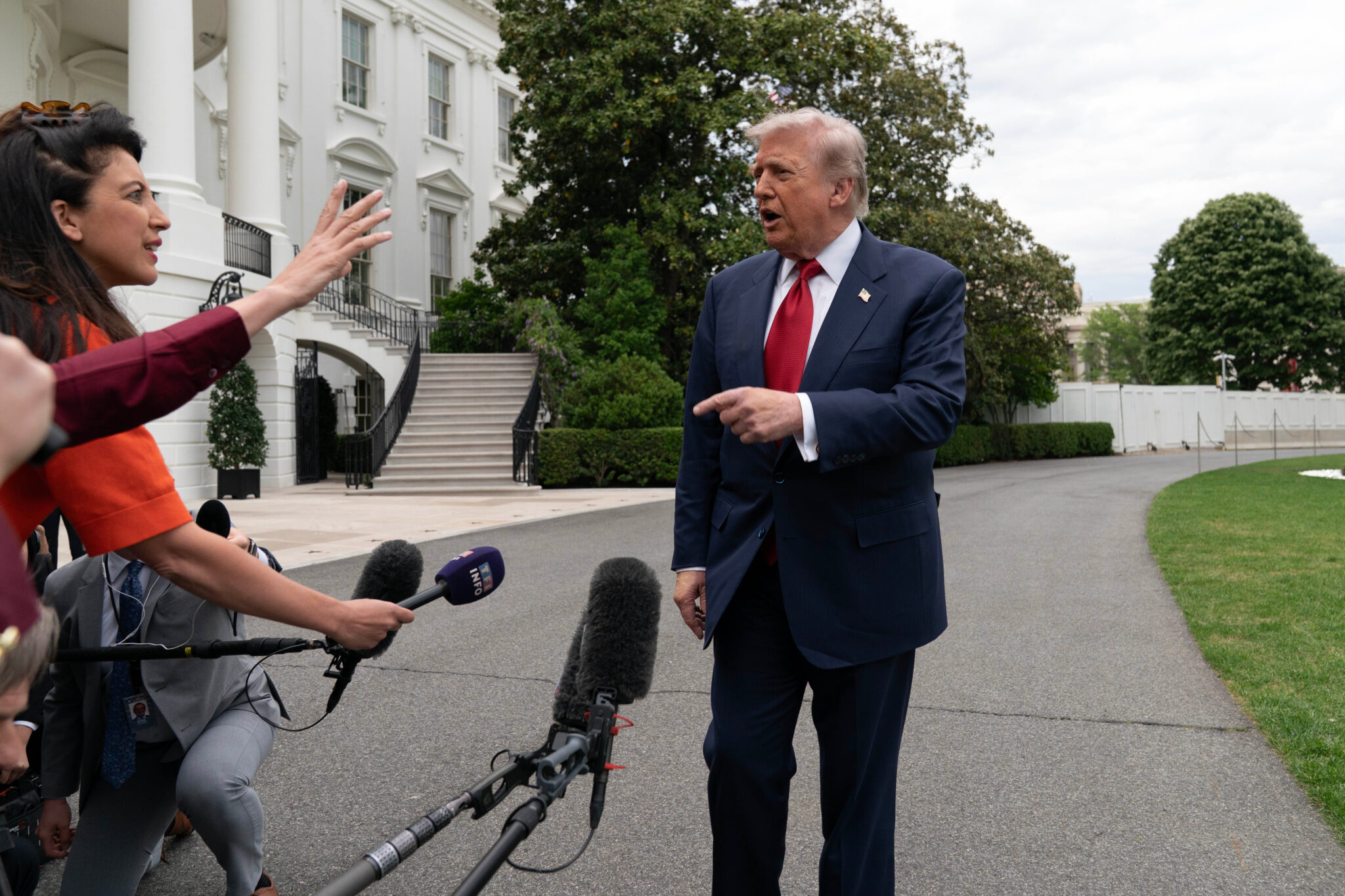
Trump Criticizes 2 Supreme Court Justices by Name over Tariff Ruling/ Newslooks/ WASHINGTON/ J. Mansour/ Morning Edition/ The Trump administration is increasingly clashing with federal courts. Judges cite repeated violations of rulings across multiple policy areas. Legal experts warn this trend could weaken the rule of law.
Trump Court Defiance Executive Power Quick Looks
- At least 31 lawsuits found violations of court orders
- Over 250 additional noncompliance cases in immigration rulings
- Judges accuse administration of undermining separation of powers
- Higher courts often side with administration, complicating enforcement
- Critics warn of long-term damage to U.S. legal system
- Administration argues it is acting within lawful authority
Deep Look
President Donald Trump issued a lengthy lament for two of his Supreme Court justices’ $159 billion ruling against tariffs and likely “ruling against us on Birthright Citizenship” and showing “so little respect to our country, and its people.”
“I don’t want loyalty, but I do want and expect it for our Country,” Trump’s 545-word Truth Social post read Sunday night, showing his disappointment in Justices Neil Gorsuch and Amy Coney Barrett. “Yes, I have another way of doing Tariffs, but it is far slower, and more laborious than what was just determined, in a close decision, to be ‘illegal’ or ‘unconstitutional,’ with three powerful, and highly accurate, dissents! Well, maybe Neil, and Amy, just had a really bad day, but our Country can only handle so many decisions of that magnitude before it breaks down, and cracks!!!”
“Sometimes decisions have to be allowed to use Good, Strong, Common Sense as a guide.”
A negative ruling on Birthright Citizenship, on top of the recent Supreme Court Tariff catastrophe, is not Economically sustainable for the United States of America!”
The birthright citizenship ruling remains pending before the Supreme Court, with a decision expected before the end of June or in early July. Trump has sought to end the practice of “birth tourism,” where foreign nationals have put their family’s stake in automatic U.S. citizenship of their children born while in the U.S.
“I choose people to help our Country, not to hurt it,” Trump’s post read, “and now, based on what I witnessed recently by being the first President in History to attend a Supreme Court session (Which fact was not even recognized or acknowledged, out of respect for the position of President, by the Court — Something which did not go unnoticed by the Fake News Media!), they will be ruling against us on Birthright Citizenship, making us the only Country in the World that practices this unsustainable, unsafe, and incredibly costly DISASTER.”
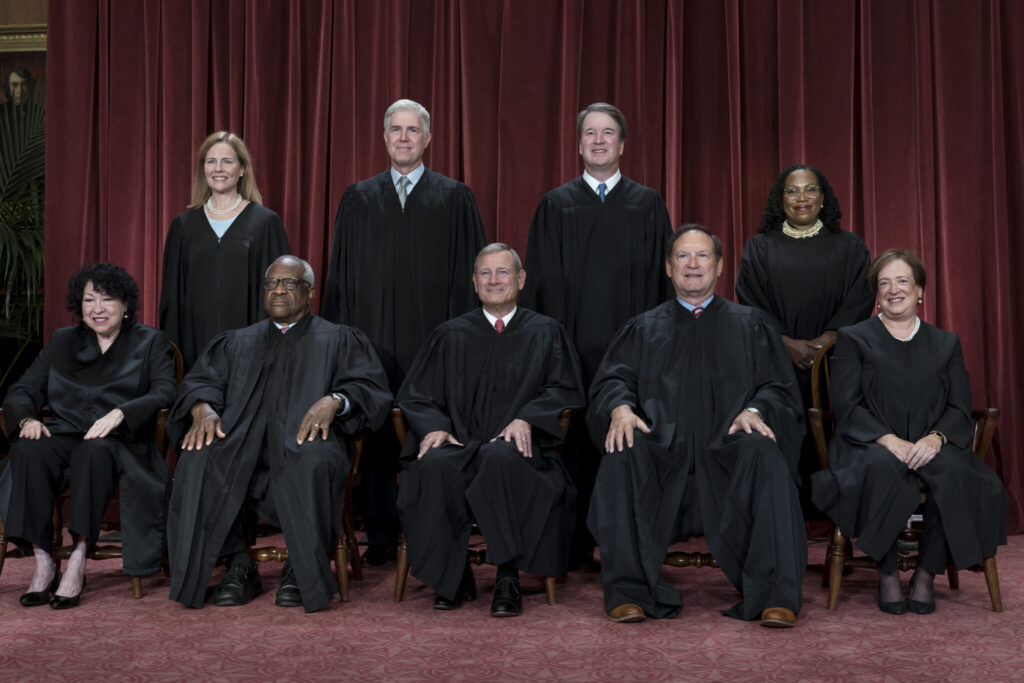
The Supreme Court delivered a 6-3 decision against Trump’s International Emergency Economic Powers Act (IEEPA) use of tariffs for national security and trade in late February. Gorsuch, Barrett and Chief Justice John Roberts ruled with liberal Justices Sonia Sotomayor, Elena Kagan and Ketanji Brown Jackson.
Justices Clarence Thomas, Samuel Alito and Brett Kavanaugh dissented against the unconstitutionality of using IEEPA to levy tariffs on foreign goods and countries amid multiple wars.
“I ‘Love’ Justice Neil Gorsuch! He’s a really smart and good man, but he voted against me, and our Country, on Tariffs, a devastating move,” Trump’s post began. “How do I reconcile this? So bad, and hurtful to our Country. I have, likewise, always liked and respected Amy Coney Barrett, but the same thing with her.
They were appointed by me, and yet have hurt our Country so badly! I do not believe they meant to do so, but their decision on Tariffs cost the United States 159 Billion Dollars that we have to pay back to enemies, and people, companies, and Countries, that have been ripping us off for years. It’s hardly believable!”
Trump added he was fine with the ruling if they had just not left the door open for companies to come back to ask for the tariffs’ money back, something the ruling did not expressly allow, but ultimately has forced the Trump administration to respond to.
“They could have solved that situation with a ‘tiny’ sentence, ‘Any money paid by others to the United States does not have to be paid back,'” Trump wrote. “Why wouldn’t they have done so?
“With certain Republican Nominated Justices that we have on the Supreme Court, the Democrats don’t really need to ‘PACK THE COURT‘ any longer. In fact, I should be the one wanting to PACK THE COURT!”
Trump suggested some of the conservative justices should follow the liberal justices’ political interpretations of the law on behalf of the people and ideology they represent.
“I’m working so hard to, MAKE AMERICA GREAT AGAIN, and then people that I appointed have shown so little respect to our Country, and its people,” he continued. “What is the reason for this? They have to do the right thing, but it’s really OK for them to be loyal to the person that appointed them to ‘almost’ the highest position in the land, that is, a Justice of the United States Supreme Court.”
“Democrat Justices always remain true to the people that honored them for that very special Nomination. They don’t waver, no matter how good or bad a case may be, but Republican Justices often go out of their way to oppose me, because they want to show how ‘independent’ or, ‘above it all,’ they are.”
Growing Pattern of Court Defiance
A growing number of federal judges have accused the Trump administration of failing to comply with court orders, highlighting an escalating conflict between the executive branch and the judiciary. The issue has become a defining feature of President Donald Trump’s second term, raising serious constitutional concerns.
One notable case began when a federal judge blocked a policy allowing immigration officials to detain migrants indefinitely without bond. Despite the ruling, administration officials argued it did not apply broadly and continued the practice.
By February, U.S. District Judge Sunshine Sykes sharply criticized the administration’s actions. She wrote that officials were attempting “to erode any semblance of separation of powers,” adding they could “only do so in a world where the Constitution does not exist.”
Widespread Violations Across Policy Areas
The conflict extends far beyond a single case. A detailed review of court records shows that in the first 15 months of Trump’s second term, judges found the administration in violation of court orders in at least 31 lawsuits.
These cases span a wide range of issues, including immigration enforcement, federal spending decisions, layoffs, and regulatory changes. The volume of violations stands out compared to previous administrations, where such instances were rare.
In addition, judges have pointed to more than 250 separate instances of noncompliance in individual immigration cases. These include failures to release detainees on time and delays in returning personal property.
Legal experts say the scale of these actions is unprecedented in modern U.S. governance.
Legal Experts Warn of Constitutional Risks
Scholars and former judges have expressed alarm over the administration’s approach to court rulings. Many argue that consistent noncompliance undermines the foundation of the American legal system.
Ryan Goodman, a law professor at New York University, described the situation as unlike anything seen before. “What the court system is experiencing in the last year and a half is just qualitatively completely different from anything that’s preceded it,” he said.
David Super, a constitutional law expert, emphasized the broader implications. “The federal government should be the institution most devoted to the rule of law in this country,” he said. “When it ceases to feel itself bound, respect for the rule of law is likely to break down across the country.”
Judges Respond With Increasing Frustration
Federal judges across the political spectrum have voiced frustration with what they see as deliberate efforts to sidestep their authority.
In one case, U.S. District Judge William Smith criticized the Department of Homeland Security for continuing to tie disaster relief funds to immigration policies despite a court order blocking the practice. He described the agency’s actions as “ham-handed” and accused it of attempting to “bully the states.”
In another ruling, Judge Jamal Whitehead accused the Justice Department of “hallucinating new text” in an appellate decision and “rewriting” it to justify its actions.
These strong statements reflect growing tensions between the judiciary and executive agencies tasked with enforcing federal law.
Administration Defends Its Actions
The Trump administration has consistently rejected claims that it is ignoring court orders. Officials argue they are operating within the boundaries of the law and frequently point to favorable rulings from higher courts.
In nearly half of the cases reviewed, appellate courts or the Supreme Court ultimately sided with the administration, either allowing policies to proceed or limiting lower court interventions.
A White House statement emphasized that the administration would “continue to comply with lawful court rulings” while implementing its policy agenda.
Supporters of the administration argue that many lower court decisions overstep judicial authority, and that appeals are a legitimate part of the legal process.
Higher Courts Play Key Role
The involvement of higher courts has complicated the legal landscape. In many cases, appellate rulings have either overturned or narrowed district court decisions, creating ambiguity around enforcement.
Critics argue that these outcomes may encourage further noncompliance by signaling that lower court rulings can be challenged or ignored until higher courts weigh in.
Supreme Court Justice Sonia Sotomayor expressed concern about this trend in a dissenting opinion. “This is not the first time the Court closes its eyes to noncompliance, nor, I fear, will it be the last,” she wrote. “Yet each time this Court rewards noncompliance with discretionary relief, it further erodes respect for courts and for the rule of law.”
Impact on Public Policy and Communities
The effects of these legal battles extend beyond Washington, impacting local communities and public services.
In California, school districts have faced uncertainty over federal education grants after the administration attempted to discontinue funding tied to diversity initiatives. Even after a judge blocked the move, states argued that new restrictions effectively undermined the ruling.
Local officials warn that such actions have real-world consequences. Budget cuts and funding delays have already led to layoffs of mental health professionals in some districts.
“We have many kids who don’t trust adults for very good reason and to be able to just swipe this grant like they’re doing …” said school administrator Lisa Claussen. “We didn’t do anything wrong.”
Long-Term Implications for U.S. Governance
The ongoing conflict between the Trump administration and federal courts raises fundamental questions about the balance of power in the U.S. government.
While legal battles between branches are not new, the scale and frequency of these disputes mark a significant departure from past norms. Experts warn that continued tensions could weaken institutional checks and balances.
As lawsuits continue to mount — now exceeding 700 — the courts remain a central arena for resolving disputes over executive authority. The outcome of these cases could shape the future of presidential power and the resilience of democratic institutions.