Trump Avoids Calling Iran Conflict a War — But Keeps Using The Word/ Newslooks/ WASHINGTON/ J. Mansour/ Morning Edition/ President Trump says the Iran conflict is not a war to avoid congressional oversight. However, he repeatedly refers to the conflict as a war in public remarks. The mixed messaging highlights tensions over presidential war powers.
Trump Iran War Messaging Quick Looks
- Trump avoids calling Iran conflict a war
- Says “military operation” instead
- Repeatedly refers to conflict as war
- Debate grows over congressional authority
- War Powers Resolution at center of dispute
- White House says authorization not required
- Lawmakers divided over terminology
- Operation described as four-to-six-week mission
- Mixed messaging fuels policy confusion
- Congressional pushback continues
Deep Look: Trump Avoids Calling Iran Conflict a War — But Keeps Using The Word
President Donald Trump says he does not consider the U.S. conflict with Iran a “war” — yet he continues to use the term in public statements, highlighting growing confusion and political tension over the scope and authority of the military campaign.
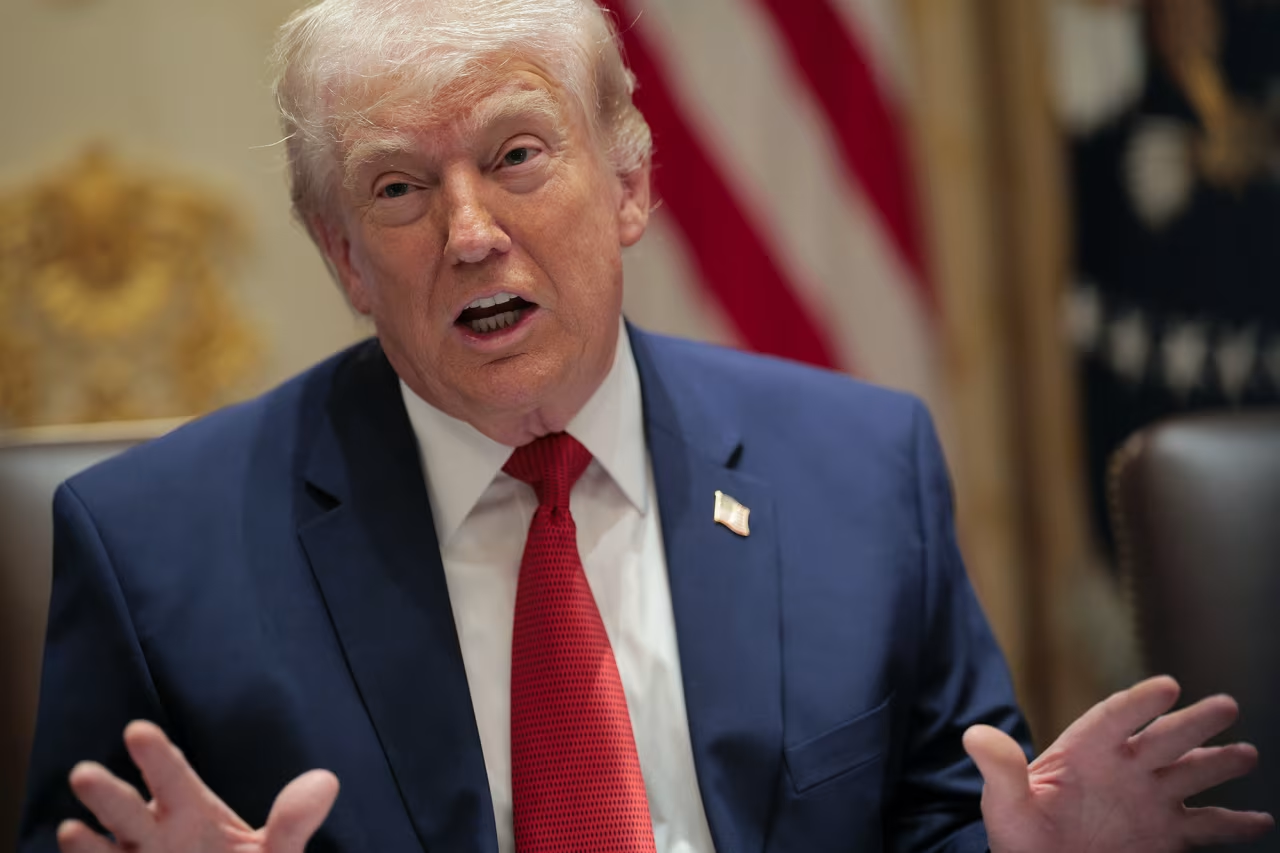
During remarks Wednesday, Trump said he intentionally avoids using the word “war” because doing so could trigger congressional oversight and approval requirements.
“They say, ‘if you use the word war, that’s maybe not a good thing to do,’” Trump said, instead describing the conflict as a “military operation” and a “military decimation.”
However, Trump contradicted himself in the same speech, referring to the Iran conflict as a “war” and claiming that the Iran “war essentially ended a few days after we went in.”
The comments underscore mixed messaging from the administration about the scale, duration, and objectives of the U.S. military involvement.
Mixed Messaging From The White House
Trump has used a range of descriptions for the Iran conflict in recent weeks, including:
- “Major combat operations”
- “A military operation”
- “A little excursion”
- “Hostilities in the Middle East”
- “A war that has been won”
Earlier this month, Trump told reporters the mission was “an excursion that will keep us out of a war,” while later calling the conflict a “war” that was “going great.”
During remarks in Memphis, Trump again sought to draw a distinction, saying Democrats call it “a war” while his administration refers to it as a “military operation.”
He also praised the decision to rebrand the defense secretary as “secretary of war,” saying the title “sounds better.”
Debate Over War Powers
The terminology debate reflects a broader legal and political battle over presidential war powers.
Under the U.S. Constitution, Congress holds the authority to declare war. However, presidents have historically initiated military actions without formal declarations, often prompting disputes with lawmakers.
The War Powers Resolution requires presidents to notify Congress within 48 hours of deploying troops and generally limits unauthorized military engagements to 60 days.
Trump has dismissed those constraints, calling the War Powers Act unconstitutional. Vice President JD Vance also criticized the law, calling it “fundamentally fake.”
Lawmakers from both parties have attempted to limit Trump’s authority to conduct military operations in Iran, though those efforts have not yet succeeded.
White House Defends Position
White House press secretary Karoline Leavitt said congressional authorization is unnecessary, noting that the United States is engaged in “major combat operations” expected to last four to six weeks.
House Speaker Mike Johnson also rejected labeling the conflict as a war, arguing that the operation is limited in scope.
Republican Rep. Cory Mills echoed that position, saying the mission “is not actually a war.”
However, other lawmakers disagree. Republican Rep. Nancy Mace warned that continued fighting could erode public and congressional support.
“The longer this war continues, the faster it will lose the support of Congress and the American people,” Mace wrote on social media.
Conflicting Messaging Continues
Trump’s shifting language has fueled uncertainty about the administration’s goals and timeline.
Earlier this month, Trump told CBS News that the conflict was “very complete.” Yet days later, he declined to call the operation a war at all.
The inconsistent messaging comes as the conflict has already resulted in hundreds of casualties and billions of dollars in costs.
Oil Market Reaction: “Well-Supplied” Despite Crisis
Meanwhile, Treasury Secretary Scott Bessent attempted to reassure markets, saying the global oil market remains “well-supplied,” despite disruptions caused by the conflict.
Bessent explained that global oil supplies remain abundant but are temporarily constrained due to the closure of the Strait of Hormuz and damage to regional infrastructure.
Earlier this year, oil prices hovered near $60 per barrel due to increased supply from OPEC+ and weaker global demand.
However, disruptions in the Middle East have limited access to supply, pushing prices higher.
Some production facilities have shut down due to storage limitations, and damaged refineries may take years to fully restore.
Despite these disruptions, futures contracts for oil deliveries in 2027 remain relatively moderate, reflecting expectations that supply will normalize once shipping routes reopen.
Bottom Line
Trump’s shifting language — calling the Iran conflict both a war and not a war — highlights growing tensions over presidential authority, congressional oversight, and the long-term trajectory of the military campaign.
As the conflict continues and economic impacts grow, the debate over whether the U.S. is officially at war with Iran remains unresolved.