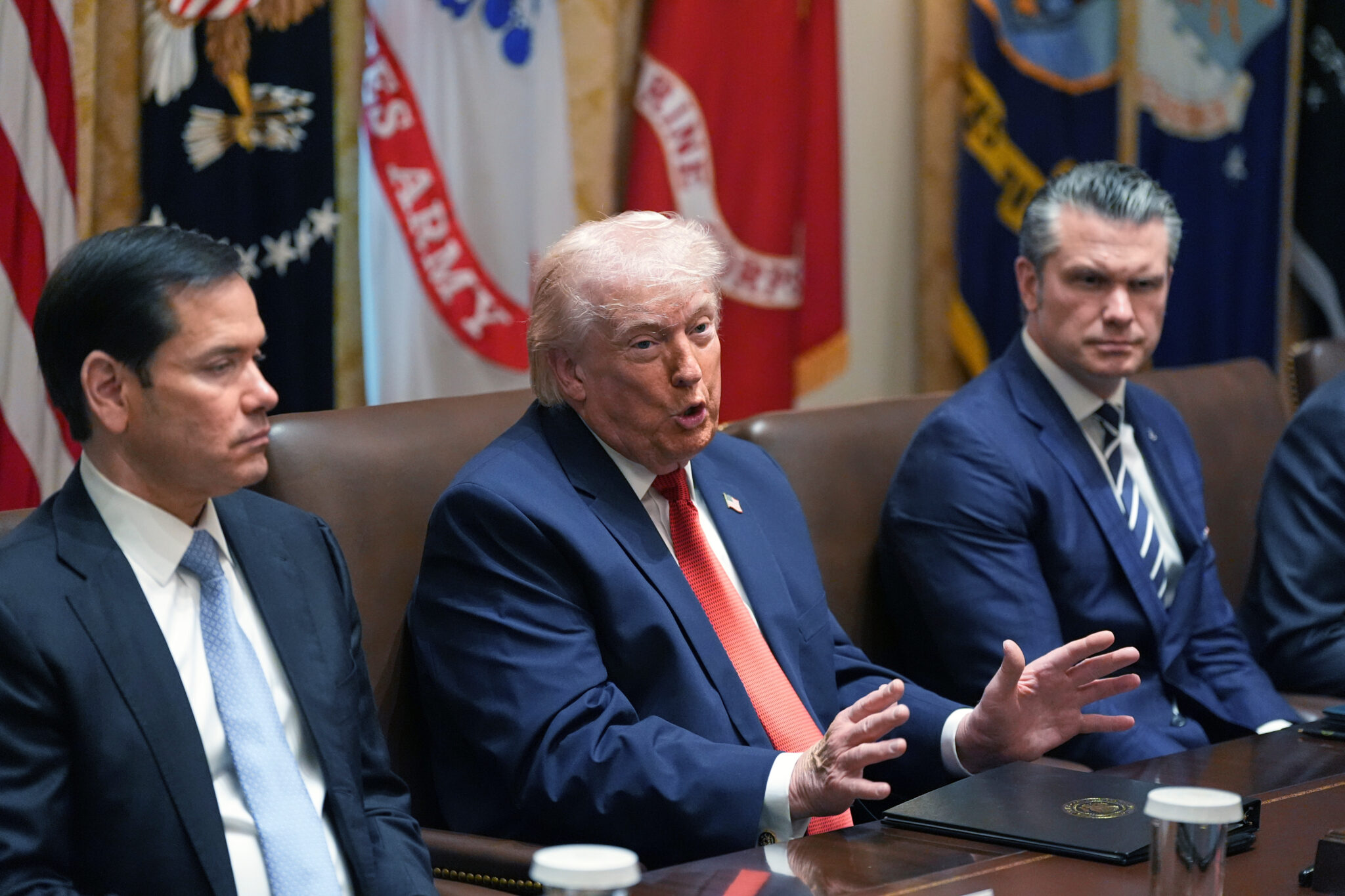
Trump Iran War Objectives Unmet One Month Into Conflict/ Newslooks/ WASHINGTON/ J. Mansour/ Morning Edition/ One month into the Iran war, President Donald Trump says the U.S. may soon wind down operations. However, several key objectives — including missile destruction and nuclear containment — remain incomplete. The evolving goals raise questions about strategy, outcomes, and long-term regional stability.
Trump Iran War Objectives Quick Looks
- Trump outlines five major war objectives
- U.S. says Iran military significantly weakened
- Iran continues missile and drone attacks
- Nuclear program not fully eliminated
- Strait of Hormuz still partially disrupted
- U.S. protecting Middle East allies remains ongoing
- Regime change not official war objective
- Iranian proxy groups still active regionally
- Talks suggested but Iran denies negotiations
- U.S. considering winding down operations

Deep Look: One Month Into Iran War, Trump Objectives Remain Unfulfilled As U.S. Eyes Wind-Down
WASHINGTON — One month into the war with Iran, President Donald Trump is signaling that U.S. military operations could soon wind down, even as several of his stated objectives remain incomplete or unclear.
Trump has outlined five key goals for the U.S. campaign, but those objectives have evolved and expanded since the conflict began on Feb. 28. While administration officials say the operation is progressing successfully, analysts note that tactical military gains have not yet translated into clear strategic victories.
White House officials insist the campaign — dubbed “Operation Epic Fury” — is nearing its core objectives. Press Secretary Karoline Leavitt said this week that the mission is “ahead of schedule and performing exceptionally.”
However, Iran continues to launch missiles, disrupt shipping, and maintain regional influence — raising questions about whether the U.S. can fully achieve Trump’s goals before ending the conflict.
Objective One: Destroy Iran’s Missile Capability
Trump has repeatedly said the United States aims to “destroy” Iran’s missile program and eliminate its ability to threaten regional allies.
Administration officials claim significant progress. Trump said roughly 90% of Iran’s missile launchers and infrastructure have been destroyed. U.S. Central Command also reports strikes on missile production facilities and drone manufacturing sites.
Yet Iran continues launching missile barrages toward Israel and Gulf states, demonstrating that its capabilities remain operational.
The continued attacks underscore the difficulty of fully eliminating missile infrastructure, particularly when facilities are dispersed or hidden.
Objective Two: Destroy Defense Industrial Base
Trump has also identified destroying Iran’s defense industry as a separate objective, though officials sometimes combine it with missile capabilities.
The Pentagon says U.S. strikes have targeted weapons factories, drone production sites, and military infrastructure.
Despite those operations, Iran continues to manufacture and deploy weapons, suggesting that eliminating the industrial base may require a longer campaign.
Objective Three: Eliminate Iran’s Navy and Air Force
U.S. and Israeli forces quickly established air superiority over Iran, conducting strikes with little resistance.
Defense Secretary Pete Hegseth said U.S. forces have damaged or destroyed more than 150 Iranian vessels. A U.S. submarine sank an Iranian warship earlier in March.
However, Iran’s Revolutionary Guard maintains a fleet of smaller vessels capable of swarm attacks and mine deployments. These forces continue to threaten shipping through the Strait of Hormuz.
Two Iranian vessels that docked in Sri Lanka and India following U.S. strikes remain unaccounted for, leaving uncertainty about remaining naval capabilities.
Objective Four: Prevent Iran From Achieving Nuclear Capability
Trump has emphasized preventing Iran from acquiring nuclear weapons as a central objective.
Recent Israeli strikes targeted Iranian nuclear-related facilities, including a heavy water plant and a uranium processing site. Iranian officials reported no casualties or contamination.
One of the biggest unresolved questions involves approximately 970 pounds of enriched uranium believed to be stored deep underground.
Trump suggested the United States could retrieve the material through negotiations. Experts say seizing it militarily would require significant troop deployments — a move the administration has not committed to.
Objective Five: Protect Middle East Allies
Trump added a fifth objective focused on protecting regional allies, including Israel, Saudi Arabia, Qatar, Bahrain, Kuwait, and the United Arab Emirates.
Iran continues launching attacks across the region, including strikes on Gulf states and U.S. installations.
Trump has also vacillated on whether the United States should help police the Strait of Hormuz. He recently extended a deadline for Iran to reopen the waterway until April 6.
The strait remains a major concern, handling roughly one-fifth of global oil shipments.
Regime Change Not Official Objective
Trump has repeatedly discussed regime change but has not formally listed it as an official goal.
Early in the conflict, Trump encouraged Iranian citizens to overthrow their government following strikes that killed senior leadership figures.
Later, Trump suggested the regime had already been weakened enough to constitute “regime change,” though Iran’s government remains in power.
Meanwhile, U.S. officials claim negotiations may be underway with Iranian leaders — something Tehran denies.
Proxy Groups Still Active
Another objective — limiting Iran’s proxy forces — remains unresolved.
Iran-aligned militia groups remain active in Iraq, while Israel has expanded operations against Hezbollah in Lebanon.
The administration has offered limited details on how it plans to permanently weaken Iran’s regional proxy network.
White House officials say Iranian-backed groups have been weakened but acknowledge the objective remains ongoing.
Political and Strategic Risks
Ending the conflict without meeting major objectives could create political risks for Trump domestically and internationally.
The war has disrupted global markets, strained alliances, and reshaped Middle East dynamics.
If the U.S. winds down operations while Iran retains military capabilities and regional influence, questions may remain about the long-term impact of the campaign.
For now, the administration continues to signal optimism while balancing military pressure with diplomatic efforts — leaving the ultimate outcome uncertain.