

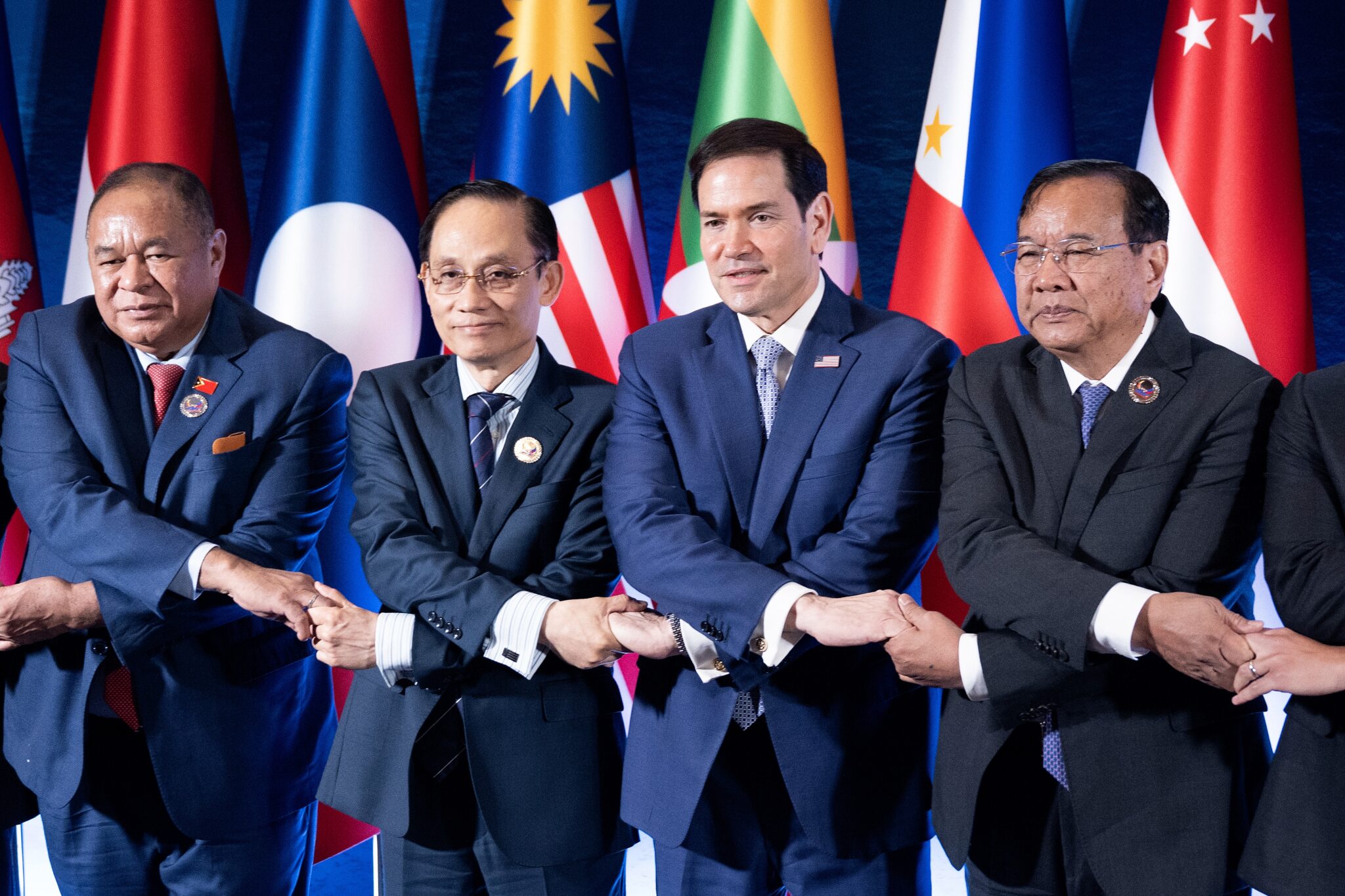
Marco Rubio Tells Asian Leaders Iran’s Hormuz Toll Plan Threatens Global Economy/ Newslooks/ WASHINGTON/ J. Mansour/ Secretary of State Marco Rubio warned Asian leaders that Iran’s effort to control the Strait of Hormuz and charge ships tolls could create a dangerous global precedent. Southeast Asian countries have been hit particularly hard by rising energy prices and disrupted oil and gas shipments resulting from the Iran war. The ASEAN gathering also addressed China’s regional influence, maritime disputes, the Ukraine war and possible U.S.-Russia diplomacy.
Quick Look
- Rubio addressed ASEAN foreign ministers in Manila, Philippines.
- He warned that Iran’s Strait of Hormuz demands threaten international shipping and the global economy.
- Rubio said Iran has contacted the United States directly and indirectly about possible talks.
- The United States remains open to diplomacy but says it will respond to attacks on ships and Americans.
- Asia received about 80% of the oil and almost 90% of the LNG passing through Hormuz in 2025.
- Australia called for a ceasefire, negotiations and reopening of the strait.
- Russia said it wants a quick end to the U.S.-Iran conflict and stable energy prices.
- Quad members reaffirmed their commitment to maritime security.
- Rubio and Chinese Foreign Minister Wang Yi discussed a recent China-Philippines confrontation.
- Rubio plans to meet Russian Foreign Minister Sergey Lavrov to discuss Ukraine.
Deep Look
Rubio Warns ASEAN Leaders About Hormuz Crisis
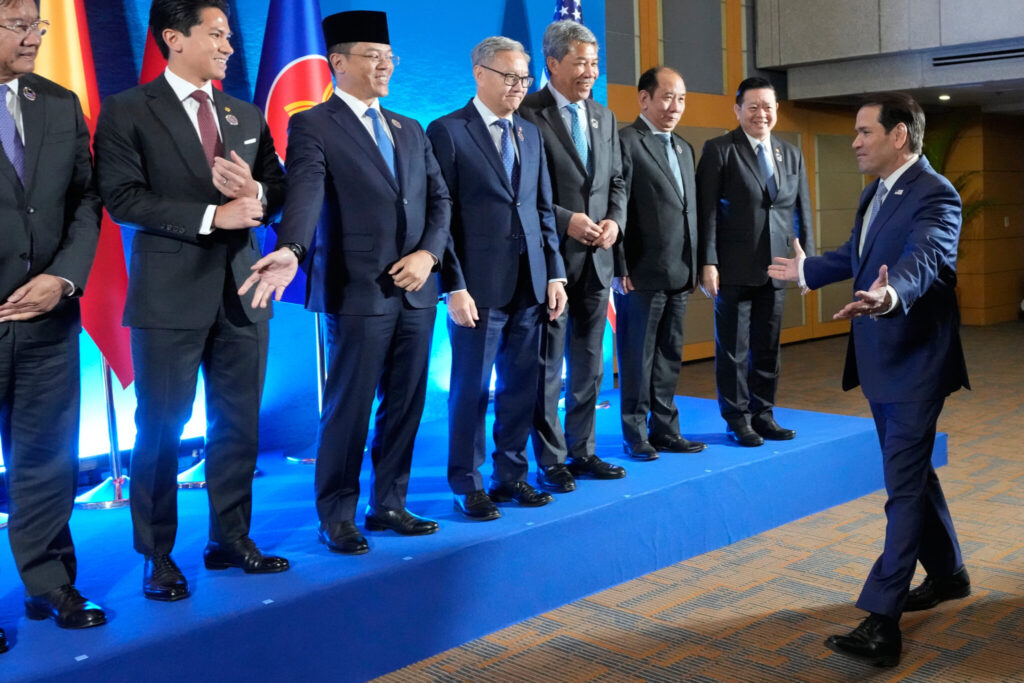
MANILA, Philippines — Secretary of State Marco Rubio warned Asian leaders Wednesday that Iran’s demand to control the Strait of Hormuz and collect tolls from passing ships threatens the global economy.
Speaking at an annual meeting with foreign ministers from the Association of Southeast Asian Nations, Rubio said allowing one country to impose control over an international waterway could encourage similar actions elsewhere.
“If we create a precedent in the Middle East where a nation-state can decide that they are going to control an international waterway, charge a toll and if you don’t pay them, blow up your ships, we have created a very dangerous precedent which will repeat itself in other parts of the world, including in this region,” Rubio said.
The gathering in Manila brought together leading diplomats from the United States, China, Russia and other countries.
Although Washington remains heavily focused on the Iran war, Rubio assured regional officials, “We’re with ASEAN 100%.”
US Says Iran Has Sought New Talks
Rubio repeated Washington’s allegation that Iran failed to honor commitments made under an interim ceasefire agreement that later collapsed.
He said Iran “has been reaching out to the United States, both directly and indirectly, to engage in talks about settling the differences.”
Rubio added that “the U.S. would love to reach a diplomatic settlement,” but said the Trump administration is “not going to sit by and let ships be blown up or Americans be attacked.”
The conflict has disrupted traffic through the Strait of Hormuz, a critical shipping route for global oil and natural gas supplies.
Russia Calls for Quick Settlement
Russian Foreign Minister Sergey Lavrov said Moscow wants the conflict between the United States and Iran resolved quickly.
“There are those eager to incite each party to keep the conflict going, but we aren’t one of those,” Lavrov told reporters.
“We would like to see it stop — it impacts the global economy and Russia is part of the global economy,” he said.
Lavrov added that Russia is “interested in stable global energy prices to pursue long-term economic policies.”
New British Foreign Secretary Ed Miliband was also expected to arrive in Manila for the ministerial gathering.
Southeast Asia Hit Hard by Energy Disruption
Southeast Asian countries are particularly vulnerable to the energy shock caused by the Iran war because of their reliance on imported fossil fuels from the Middle East.
The International Energy Agency described the crisis as a “stark wake-up call” for regional energy security.
Asian markets received approximately 80% of the crude oil and nearly 90% of the liquefied natural gas transported through the Strait of Hormuz in 2025, according to the agency.
Disruptions in the waterway have driven up energy costs for governments, companies and consumers throughout the region.
Australia Calls for Ceasefire and Negotiations
Australian Foreign Minister Penny Wong warned that “the situation could deteriorate further without much warning.”
“We want to see an end to this war. We want to see a ceasefire. We want to see negotiations and we want the strait to be opened,” Wong told reporters.
“People are being affected by what is happening and has happened to global energy markets and the effect on people has been direct and personal,” she added.
Quad Reaffirms Maritime Security Commitments
Rubio also met with officials from the Quad, a partnership comprising the United States, Australia, India and Japan.
The diplomats discussed maritime security, transnational threats and efforts to counter China’s growing regional influence. Their joint statement reaffirmed support for maritime security initiatives in the Indo-Pacific.
Japanese Foreign Minister Toshimitsu Motegi opposed attempts to change the regional status quo through force, including in the disputed South China Sea and East China Sea.
China claims Japanese-controlled islands in the East China Sea, creating a longstanding dispute between Beijing and Tokyo.
Wong also expressed concern about Chinese conduct, saying, “We have real concerns about behavior that is destabilizing and risky.”
Rubio and Wang Discuss China-Philippines Clash
Rubio met separately with Chinese Foreign Minister Wang Yi.
The two officials discussed a new confrontation between Chinese and Philippine forces at a disputed shoal. Rubio characterized the incident as “escalatory.”
“It speaks to areas of disagreement when it comes to our policies with China,” Rubio said. “Those need to be managed very carefully, because obviously, a conflict — be it economic or otherwise — between the U.S. and China would have a dramatic global impact.”
The United States has repeatedly criticized China’s increasingly forceful actions in the South China Sea, particularly those affecting smaller countries with competing territorial claims. The Philippines is Washington’s oldest treaty ally in Asia.
Trump-Xi Meeting Could Produce Trade Progress
Rubio and Wang also discussed a trade board intended to give the two governments a forum for addressing disputes involving certain products.
Rubio said he hoped progress through the board could become a “deliverable” from a planned September meeting in the United States between Trump and Chinese President Xi Jinping.
According to China’s Foreign Ministry, Wang objected to “recent negative words and actions by the U.S. side.”
The ministry did not identify the specific actions. Trump recently accused China of interfering in the 2020 U.S. election, while his administration reduced visa durations for Chinese journalists.
ASEAN Discusses South China Sea Pact
ASEAN foreign ministers also reviewed regional territorial disputes.
They welcomed progress in lengthy negotiations with China over a proposed nonaggression agreement for contested waters.
The pact is intended to prevent a major confrontation in the South China Sea that could involve the United States.
Rubio and Lavrov to Discuss Ukraine
Rubio said he plans to meet Lavrov on Thursday to discuss the war in Ukraine and possible areas of cooperation between Washington and Moscow.
The United States remains willing to help end the war “if that opportunity presents itself,” Rubio said.
He acknowledged that diplomatic efforts have “kind of fallen off a little bit over the last few months,” but said he would explore whether talks could be renewed.
Lavrov said he plans to ask Rubio about Trump’s assertion that an agreement to end the Ukraine war is approaching.
Rubio also met Indian External Affairs Minister Subrahmanyam Jaishankar. According to a U.S. official, they discussed the Iran conflict, regional affairs and an unfinished trade agreement intended to reduce American tariffs on Indian goods.


You must Register or Login to post a comment.