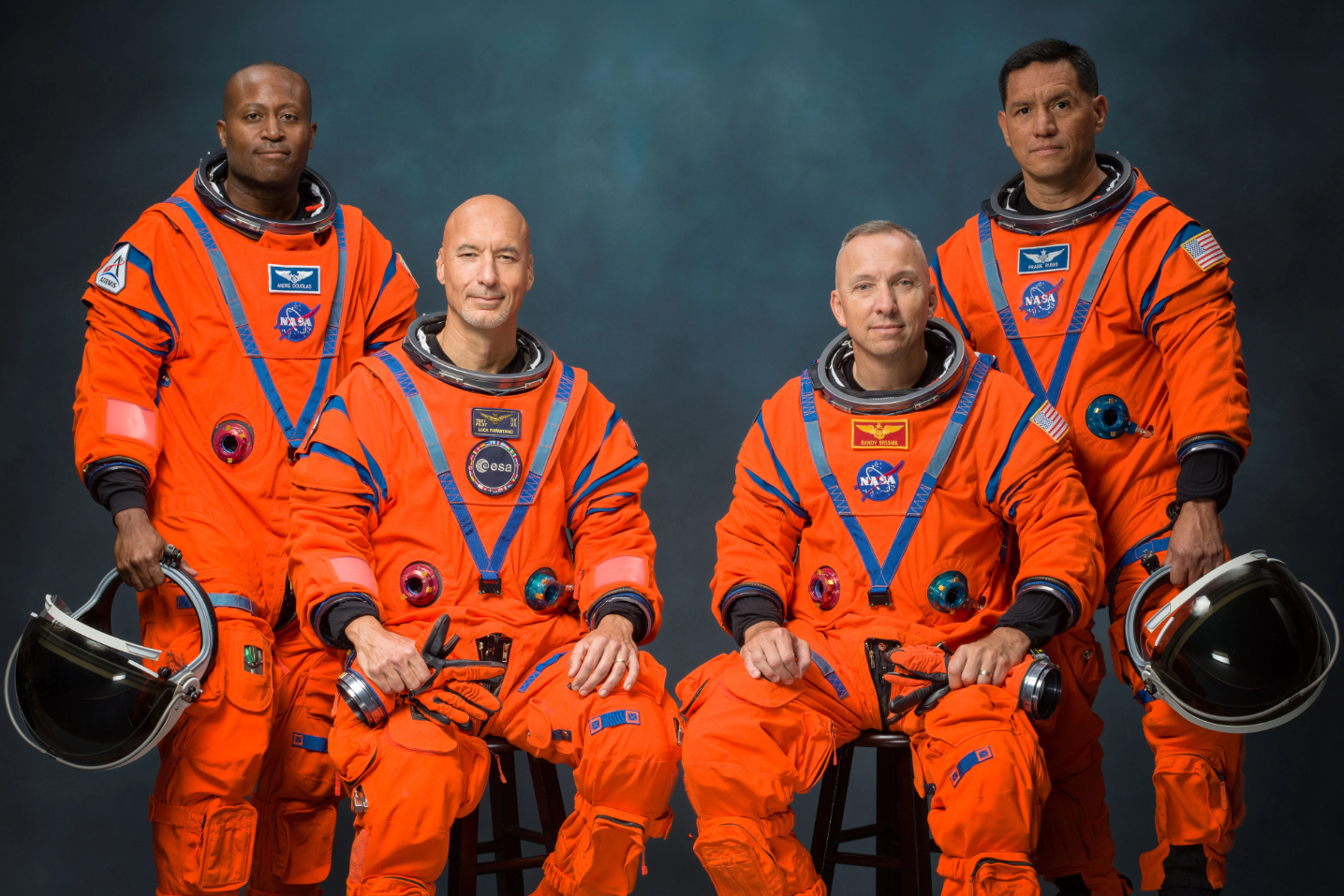
NASA Names Artemis III Crew to Prepare for Future Moon Landing Mission/ Newslooks/ WASHINGTON/ J. Mansour/ Morning Edition/ NASA has announced the four astronauts selected for the Artemis III mission, a key step toward returning humans to the moon. The crew will test docking procedures between the Orion spacecraft and competing lunar landers from SpaceX and Blue Origin. The mission is expected to help pave the way for a future lunar landing and long-term plans for a moon base and eventual missions to Mars.

Artemis III Crew Quick Looks
- NASA unveiled the four-member Artemis III crew on Tuesday.
- The mission follows the success of the record-breaking Artemis II lunar flyby.
- Randy Bresnik will command the mission.
- Frank Rubio, Andre Douglas and ESA astronaut Luca Parmitano complete the crew.
- Artemis III will orbit Earth rather than travel to the moon.
- Astronauts will practice docking with lunar landers in space.
- SpaceX and Blue Origin are competing to provide the lander technology.
- The mission is currently targeted for 2027.
- NASA aims to return humans to the moon later in the Artemis program.
- The long-term goal remains establishing a lunar base and preparing for Mars missions.
Deep Look
NASA Reveals Artemis III Astronaut Team
NASA has officially introduced the astronauts who will fly on the Artemis III mission, a critical test flight designed to prepare the agency for future lunar landings and deep-space exploration.
The announcement comes just two months after the highly successful Artemis II mission, which completed a record-breaking journey around the moon and surpassed the distance record previously held by the crew of Apollo 13.
While Artemis III will not land astronauts on the moon, the mission is considered a major stepping stone toward NASA’s broader goal of returning humans to the lunar surface for the first time since the Apollo era.
The crew will focus on testing key technologies and procedures that will be required for future moon landings.
Meet the Artemis III Crew
NASA selected four veteran astronauts for the mission:
- Randy Bresnik (Mission Commander)
- Frank Rubio (Pilot)
- Andre Douglas (Mission Specialist)
- Luca Parmitano of the European Space Agency (Mission Specialist)
The multinational crew represents NASA’s continued collaboration with international partners as the Artemis program expands beyond the United States.
During the announcement ceremony, NASA Administrator Jared Isaacman praised the astronauts and the mission ahead.
“To the Artemis III crew, we wish you Godspeed on the journey ahead,” said NASA administrator Jared Isaacman.
The astronauts themselves emphasized both the responsibility and excitement surrounding the mission.
“We are certainly humbled as a crew to be able to be your crew that executes this Artemis III mission in space,” said Bresnik, Artemis III commander.
Added Douglas, mission specialist: “My brain — it is going a mile a minute right now. But my heart, it is so warm. It is so full.”
Artemis III Will Focus on Lunar Landing Technology
Unlike Artemis II, which traveled around the moon, Artemis III is designed primarily as a technology demonstration mission.
The astronauts will remain in Earth orbit while practicing complex docking maneuvers between NASA’s Orion spacecraft and two different lunar landing systems.
These docking exercises are considered essential before astronauts can safely descend to the lunar surface in future missions.
The operation will test communications, navigation systems, crew procedures and vehicle compatibility under realistic mission conditions.
NASA officials view the mission as a vital rehearsal that will reduce risks before attempting another human moon landing.
SpaceX and Blue Origin Compete for Lunar Landing Contracts
A major element of Artemis III involves testing lunar landers being developed by two of the world’s leading private space companies.
Elon Musk’s SpaceX and Jeff Bezos’ Blue Origin are both working to provide spacecraft capable of transporting astronauts between lunar orbit and the moon’s surface.
The Artemis III mission will allow NASA to evaluate critical systems from both companies.
Competition between the firms has become one of the defining elements of the Artemis program, with each company racing to demonstrate reliability and readiness.
The mission’s docking tests are expected to provide valuable data that could influence future lunar exploration strategies.
Blue Origin Faces Recent Challenges
The announcement comes as Blue Origin works to recover from a significant setback.
Recently, one of the company’s massive rockets exploded during an engine test at a launch facility in Florida. The explosion reportedly shook nearby communities and lit up the night sky with a large fireball.
Despite the incident, NASA remains confident in Blue Origin’s ability to meet future deadlines.
NASA official Jeremy Parsons described the failure as part of the learning process associated with developing advanced spaceflight systems.
He indicated that the agency still expects Blue Origin’s hardware to be ready in time for upcoming Artemis objectives.
Artemis Program Aims to Return Humans to the Moon
NASA’s Artemis initiative represents the agency’s most ambitious human spaceflight program since Apollo.
The program seeks not only to land astronauts on the moon again but also to establish a sustainable long-term presence there.
The Artemis missions are designed to test technologies, operational procedures and infrastructure needed for repeated lunar visits.
The effort also serves as a proving ground for future human missions to Mars.
Returning to the moon is viewed as an essential intermediate step that allows NASA to develop and refine systems needed for much longer journeys deeper into space.
Program Revamp Accelerates Lunar Ambitions
NASA recently restructured portions of the Artemis program under the leadership of Isaacman.
The revised roadmap is intended to accelerate progress and recapture some of the rapid development pace that characterized the Apollo era during the 1960s.
The addition of Artemis III as a dedicated technology-testing mission reflects NASA’s desire to reduce risk while still moving aggressively toward future lunar landings.
Current plans envision a moon landing mission in 2028 if development milestones continue to be achieved.
NASA believes that each Artemis mission will build upon the last, gradually increasing operational complexity and capabilities.
Building Toward a Permanent Lunar Presence
Beyond individual missions, NASA has much larger ambitions for the Artemis program.
In May, the agency awarded contracts worth hundreds of millions of dollars to several companies, including Blue Origin, to develop technology for future lunar infrastructure.
The contracts cover projects such as:
- Lunar landers
- Surface rovers
- Exploration drones
- Moon base technologies
The objective is to establish a sustainable human presence on the moon rather than conduct brief visits.
According to Isaacman, the moon base concept is intended to become a foundation for future human exploration of Mars.
Mars Remains the Ultimate Goal
While the Artemis missions focus on lunar exploration, NASA views the moon as preparation for an even greater challenge.
The agency ultimately wants to send astronauts to Mars, a mission that would require technologies and operational experience far beyond what is currently available.
By developing lunar habitats, transportation systems and long-duration mission capabilities, NASA hopes to gain the knowledge needed for future interplanetary travel.
The Artemis III crew will play an important role in that journey.
Though their mission will remain in Earth orbit, the lessons learned from their flight could help shape the future of human exploration beyond the moon and eventually toward the Red Planet.