

US Military Fires on Merchant Ship Accused of Breaching Iran Port Blockade/ Newslooks/ WASHINGTON/ J. Mansour/ The US military said it disabled the M/T Lavine after the merchant vessel repeatedly attempted to breach Washington’s blockade of Iranian ports. Iran claimed attacks against American military facilities in Kuwait and Bahrain as the United States continued strikes on Iranian military sites. The widening conflict has disrupted two major shipping corridors, stranded thousands of mariners and pushed global oil and gasoline prices higher.

Quick Look
- US forces fired into the M/T Lavine’s engine room in the Gulf of Oman.
- Central Command said the vessel ignored warnings and tried to breach the blockade at least four times.
- It was the second commercial vessel disabled since the blockade was reimposed.
- Trump met national security advisers to discuss whether to escalate the war.
- Iran claimed strikes against US facilities in Kuwait and Bahrain.
- Bahrain and Jordan said they intercepted Iranian aerial attacks.
- The Houthis targeted Saudi oil tankers and threatened Saudi-linked shipping.
- Saudi Arabia responded with strikes in Yemen.
- About 6,000 mariners were stranded aboard roughly 400 vessels near the Strait of Hormuz.
- Brent crude traded near $96, while average US gasoline reached $4.11 per gallon.
Deep Look
US Disables Merchant Vessel in Gulf of Oman
IRBIL, Iraq — The US military said Friday that it fired on a merchant vessel accused of repeatedly attempting to breach the American blockade of Iranian ports.
American forces disabled the M/T Lavine in the Gulf of Oman after the ship tried to cross the blockade at least four times, US Central Command spokesperson Capt. Tim Hawkins told The Associated Press.
Hawkins said the crew received warnings but did not follow military instructions. US forces then fired into the vessel’s engine room.
The Lavine became the second commercial ship disabled since Washington reimposed its blockade.
Information about casualties, the crew’s condition, the ship’s cargo and its ownership was not immediately provided.
Conflict Continues After 13 Consecutive Nights of Strikes
The maritime confrontation came after 13 consecutive nights of US attacks on Iran, with neither side showing signs of backing down.
US embassies warned Americans in the Middle East that options for leaving the region could become increasingly limited.
Iran’s Revolutionary Guard separately advised residents of neighboring countries to remain away from bases hosting American forces.
The competing warnings suggested that both governments were preparing for the possibility of a wider escalation.
Trump Reviews Options With National Security Team
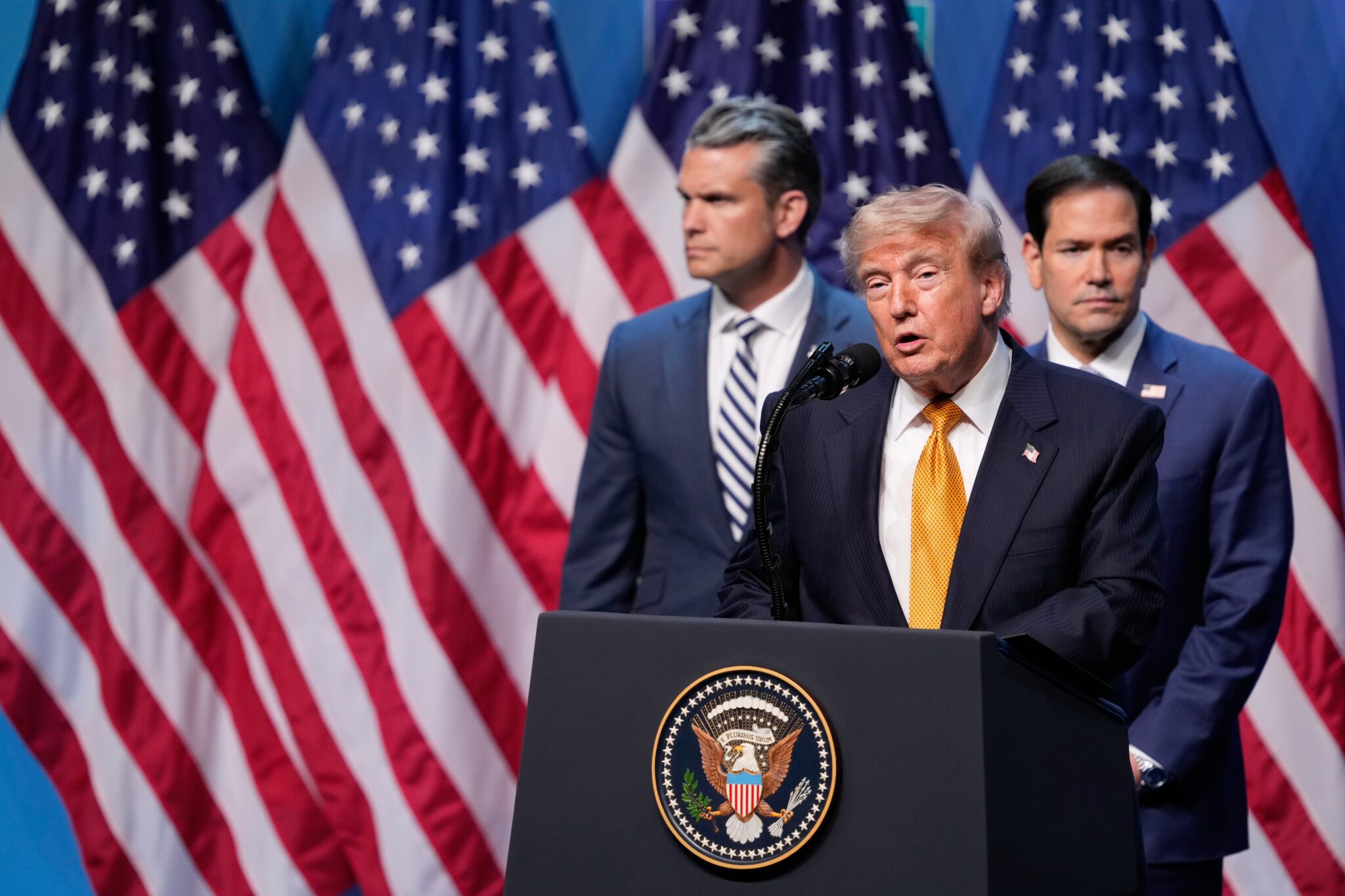
President Donald Trump met senior national security officials Friday to consider whether the United States should continue its existing operations or intensify attacks against Iran.
A US official confirmed the meeting on condition of anonymity because the discussions were private. It was not immediately clear whether Trump approved any new military action.
The White House did not immediately comment.
During an Oval Office event, Trump characterized negotiations with Iran as “by far the most serious that we’ve seen,” despite the continuing US strikes.
He also said he was “not in a hurry” to end the war.
Iran Says It Will Resist US Pressure
Iranian Foreign Minister Abbas Araghchi said Tehran would continue resisting Washington while maintaining talks with China and Russia.
Araghchi said Iran “will not bow to U.S.” bullying.
In an interview with the semiofficial Tasnim news outlet, he added that the Islamic Republic is “neither intimidated by threats nor will we yield to pressure.”
No diplomatic breakthrough was publicly announced.
Iran Claims Attacks on US Facilities
Iran’s Revolutionary Guard said it targeted an American military base at Udairi, Kuwait, and destroyed three ammunition and storage facilities.
It also claimed that an attack damaged a watchtower used by the US Navy’s Fifth Fleet in Bahrain.
US Central Command did not respond to questions about those claims, which could not immediately be independently verified.
Bahrain and Jordan separately said they intercepted Iranian aerial attacks Friday.
Drones Shot Down Near US Presence in Iraq
Security officials in Irbil said US-led forces shot down five drones carrying explosives near the northern Iraqi city.
Explosions were heard across Irbil, the capital of Iraq’s semiautonomous Kurdish region. Black smoke rose near the airport, where American military advisers are based.
US military officials did not immediately comment on the reported drone attacks.
US Strikes Iranian Military Sites
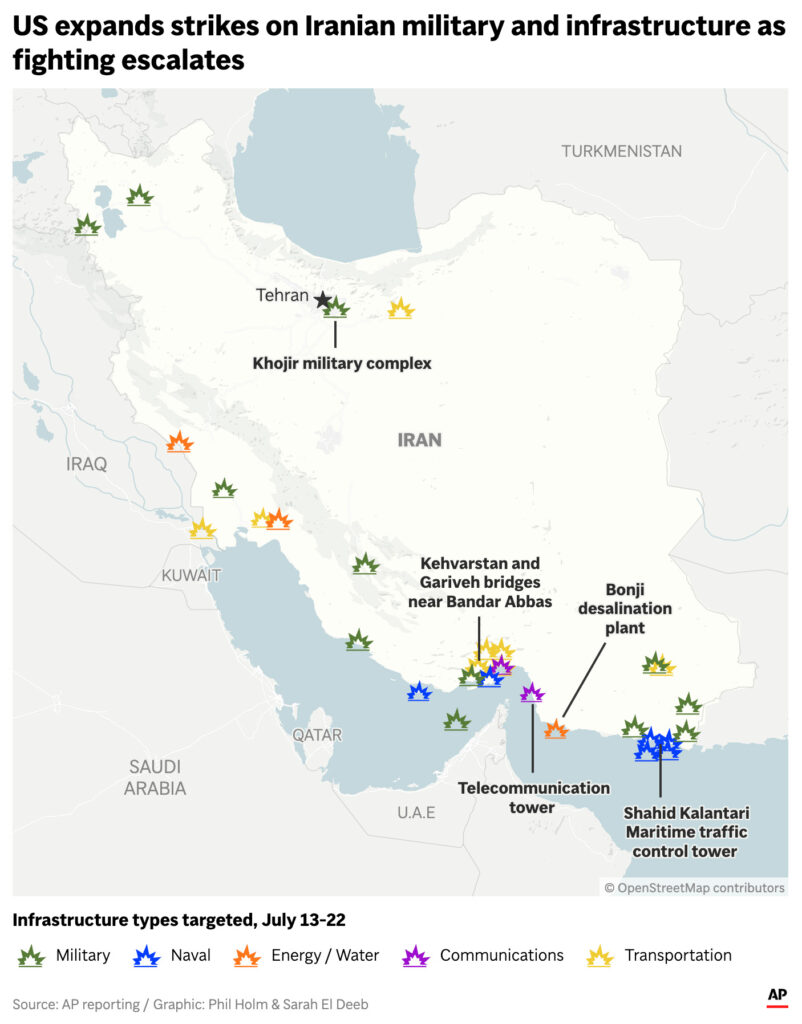
As Iran and its allies targeted American and allied facilities, US forces attacked sites across Iran.
Iranian semiofficial news organizations Fars and ISNA reported that the United States hit a Revolutionary Guard naval base in northern Iran.
Explosions were also reported on Qeshm Island, where Iran maintains naval assets that include drone boats capable of attacking vessels in the Strait of Hormuz.
Additional bombardments were reported in Isfahan province, which contains a major air base and one of Iran’s nuclear facilities, as well as in Khuzestan and Fars provinces.
Central Command said the attacks were intended to “further degrade Iran’s ability to threaten civilian mariners and commercial vessels transiting regional waters.”
Strait of Hormuz Remains Central to War
The Strait of Hormuz has become a central battleground because of its importance to global energy supplies.
Approximately one-fifth of the world’s oil and gas passed through the waterway during peacetime. Iranian attacks have effectively closed the passage, contributing to higher fuel prices and widespread economic disruption.
An Omani diplomatic delegation visited Tehran Friday to discuss management of shipping traffic through the strait, according to Iran’s state news agency.
Oman has played a mediation role between Washington and Tehran, but no agreement on reopening the passage was announced.
Iran’s ability to restrict shipping through Hormuz gives Tehran significant leverage in any future negotiations.
Houthis Expand Pressure in Red Sea
Iran’s Houthi allies in Yemen have increased pressure on another essential maritime corridor.
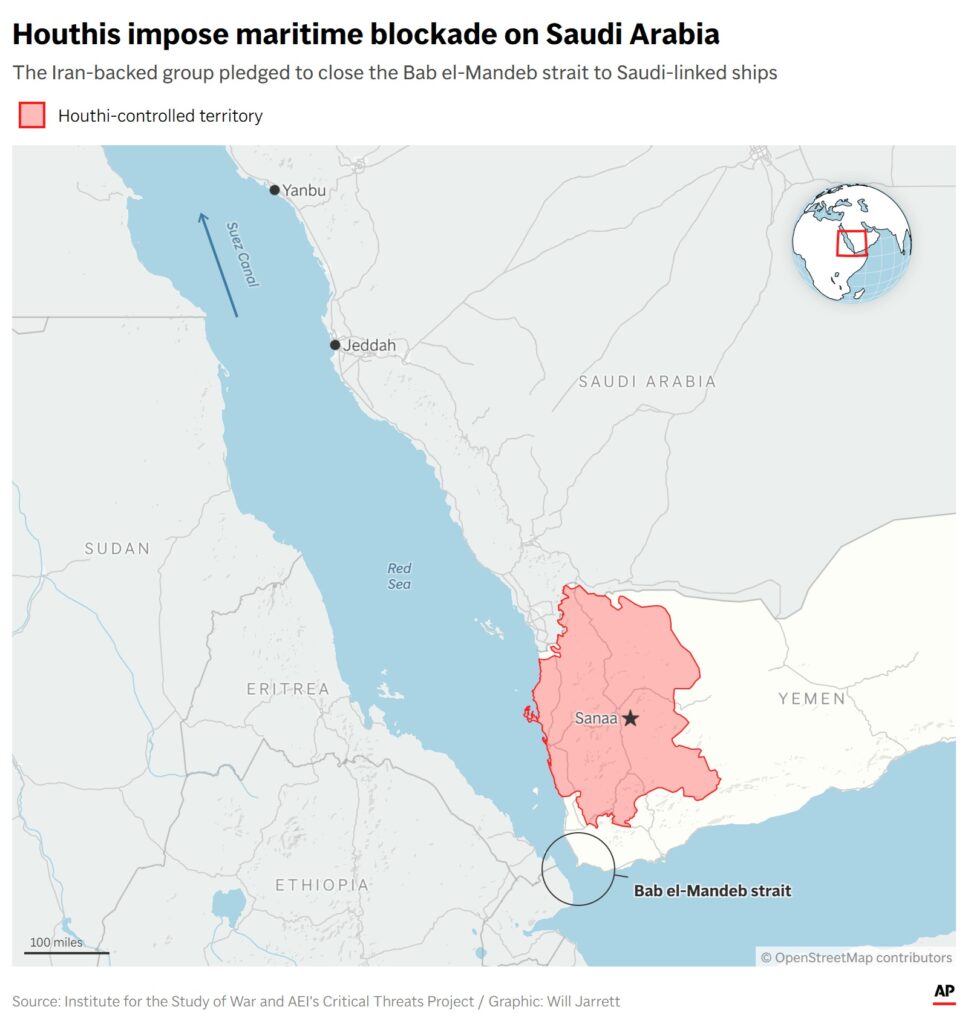
The Houthis attacked two Saudi oil tankers in the Red Sea on Thursday after threatening to close the Bab el-Mandeb Strait to Saudi-linked shipping.
Saudi Arabia’s Transport General Authority also said another Saudi vessel was targeted Friday and sustained minor hull damage, according to the state-run Saudi Press Agency.
The Bab el-Mandeb connects the Red Sea with the Gulf of Aden. About 12% of world trade—including approximately one-quarter of global container traffic—passes through the route.
The corridor has become increasingly important to Saudi Arabia as it diverts millions of barrels of oil around the effectively closed Strait of Hormuz.
Saudi Arabia Responds With Yemen Strikes
The Saudi-led coalition in Yemen said Saudi Arabia struck Hodeida after the Houthi attacks on its tankers.
Houthi-run Al Masirah television reported early Saturday that the strikes hit facilities belonging to Yemen’s state telecommunications corporation and locations on Kamaran Island off the western coast.
The broadcaster said a telecommunications employee and a woman on Kamaran Island were wounded.
Saudi Arabia warned that it would take all necessary measures to protect its vessels.
It said that if the Houthis continued their “hostile acts then there will be no hesitation in responding.”
Trump has also threatened “major military punishment” against the Houthis if their attacks continue.
Oil and Gasoline Prices Remain Elevated
That remained substantially higher than the approximately $72 price recorded before the war.
The average US gasoline price rose to $4.11 per gallon, according to AAA.
Continued disruptions in both the Strait of Hormuz and Bab el-Mandeb could create additional pressure on energy markets, shipping costs and consumer prices.
Thousands of Mariners Stranded
The International Maritime Organization said at least 6,000 mariners were stranded aboard approximately 400 vessels near the Strait of Hormuz.
The office of U.N. human rights chief Volker Türk said some seafarers had been abandoned by shipowners, forcing them to “fend for themselves without food, water, fuel, medical care, electricity or means to communicate with their families.”
The disruption has therefore created a humanitarian crisis in addition to its military and economic consequences.
Iran Reports More Than 3,400 Deaths
Iran’s Health Ministry said 3,434 people had been killed since the war began.
The figure was supplied by Iranian authorities and may be subject to revision as the conflict continues.
Pakistan’s foreign minister, Ishaq Dar, met Araghchi on Friday as Islamabad continued its diplomatic efforts.
Before the meeting, Araghchi suggested that Iran did not need additional mediators and said the United States must change its position.
Netanyahu Plans Washington Visit
The United States and Israel launched their campaign against Iran on Feb. 28.
The governments have identified several objectives during the war, including eliminating Iran’s nuclear program and, at times, toppling its government.
Israel has recently signaled that it could rejoin major combat operations. Prime Minister Benjamin Netanyahu’s office said he would travel to Washington the following week to meet Trump.
The planned visit, continuing military preparations and absence of visible diplomatic progress have increased concern that the conflict could enter a more destructive phase.






You must Register or Login to post a comment.