

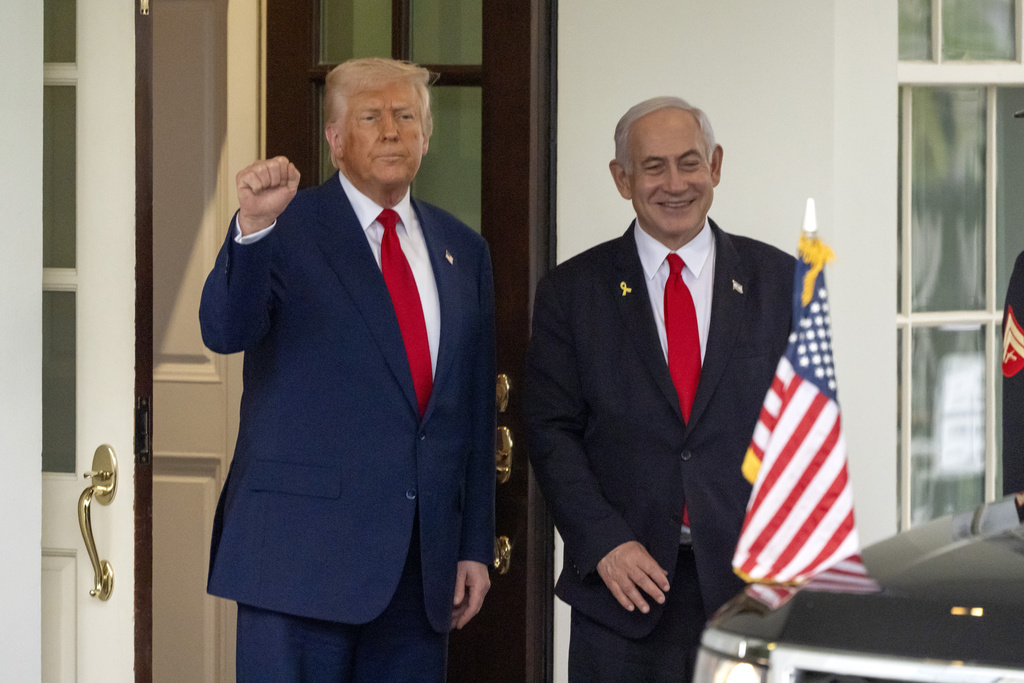
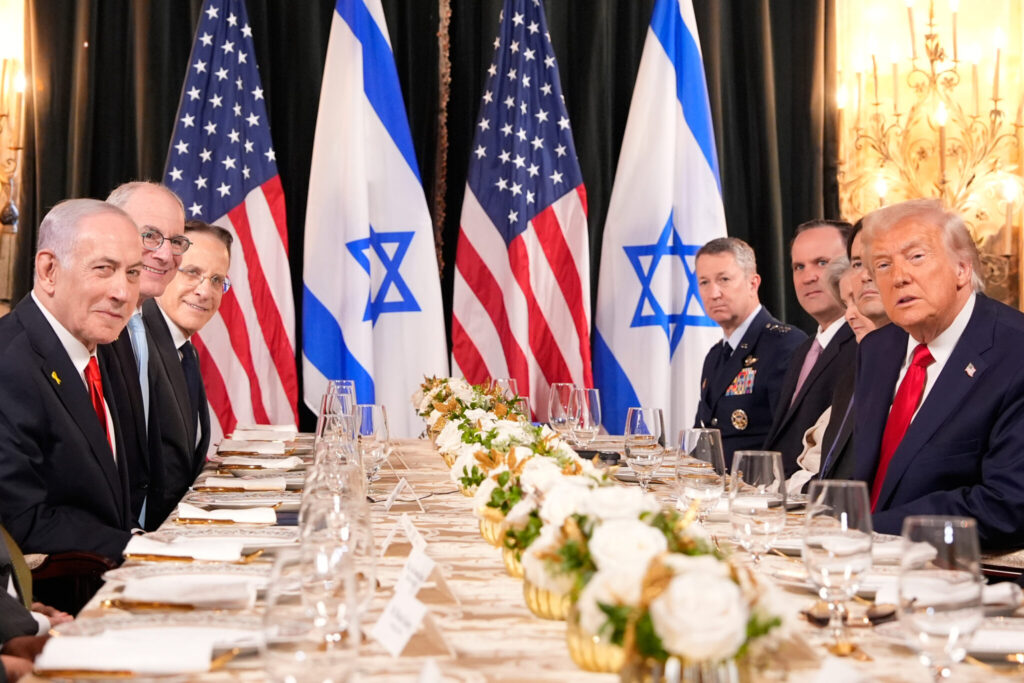
Trump Allies Warn Netanyahu’s Iran Strategy Could Deepen U.S. Involvement/ Newslooks/ WASHINGTON/ J. Mansour/ President Donald Trump’s anti-interventionist allies fear Benjamin Netanyahu will press for expanded U.S. military action against Iran. The White House meeting comes after nearly two weeks of reciprocal U.S.-Iran attacks paused amid renewed diplomatic efforts. Trump and Netanyahu are also expected to discuss Lebanon and expanding the Abraham Accords as tensions strain their relationship.
Quick Look
- Trump and Netanyahu are meeting for the first time since the Iran war began.
- Netanyahu is making his seventh U.S. visit since Trump returned to office.
- Some America First figures fear Israel will advocate a major escalation.
- Steve Bannon called Netanyahu’s visits “a disaster for America First.”
- U.S. and Iranian strikes were paused over the weekend.
- Trump has threatened to resume military operations if negotiations fail.
- The agenda includes Iran, Lebanon and the Abraham Accords.
- Netanyahu faces an Israeli election in October.
- Trump faces domestic political pressure ahead of the November midterms.
- Supporters of Israel say both leaders remain committed to preventing a nuclear-armed Iran.
Full Rewritten Story
America First figures fear pressure for escalation
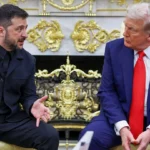
WASHINGTON — President Donald Trump’s meeting with Israeli Prime Minister Benjamin Netanyahu is causing alarm among some of Trump’s anti-interventionist allies, who fear the Israeli leader will advocate deeper American involvement in the war with Iran.
Netanyahu reportedly persuaded Trump during their previous White House meeting to join Israel in launching military action against Iran. Their latest discussion comes as the United States weighs whether to give renewed diplomacy more time or begin another aggressive phase of the conflict.
“I think all of President Trump’s most ardent non-‘Israel First’ supporters are furious,” former White House chief strategist Steve Bannon said. “Netanyahu has had twice as many visits to the White House in 18 months as Churchill had in all of World War II — with every one of them a disaster for America First.”
Netanyahu traveled to Washington primarily to attend the funeral of Sen. Lindsey Graham. His meeting with Trump is their first since the United States and Israel attacked Iran in February.
It is also Netanyahu’s seventh visit to the United States since Trump began his second term in 2025.
Meeting comes during a fragile pause in attacks
The White House talks arrive at a decisive point in the five-month war.
The United States and Iran paused almost two weeks of reciprocal strikes over the weekend as mediators pursued another ceasefire arrangement. The lull followed the collapse of an earlier agreement in July.
Despite the pause, Trump has continued threatening Iran with “massive attacks” if diplomatic efforts fail.
Many non-interventionist members of Trump’s coalition had hoped the temporary cessation of strikes would become a permanent end to the conflict. They now worry Netanyahu could encourage Trump to launch a larger military campaign that keeps the United States involved for months or years.
Recent polling cited in the report indicates that a growing portion of Trump’s political base does not believe the war justifies its economic costs. Republican officials have also increasingly accepted that the conflict could remain an election issue when voters cast ballots in November.
Curt Mills, executive director of The American Conservative magazine, characterized the Trump-Netanyahu meeting as “DEFCON 1.”
“Netanyahu is going to argue for the essential logic of escalation, which — if Trump is not willing to give the [memorandum of understanding] a chance and if Trump is not willing to walk away from the conflict entirely without a resolution — then I think we probably will escalate, and that’s what we’ve been seeing these last couple of weeks,” Mills said.
Netanyahu expected to advocate Israel’s security agenda
Some Trump allies acknowledge that Netanyahu, as Israel’s prime minister, would be expected to advocate military action that he believes could permanently prevent Iran from developing nuclear weapons.
The central concern among them is whether Israel’s preferred strategy aligns with American interests.
Alex Gray, who served as National Security Council chief of staff during Trump’s first administration, said he would be watching how directly Netanyahu seeks additional American participation.
“I’m interested in seeing how forward-leaning Netanyahu is about wanting a U.S. engagement in that way. I mean, is that something he wants to do privately? Is that something he’s going to say publicly?” Gray said. “Netanyahu is going to push his agenda, which I don’t think in this instance necessarily is compatible with our interests, but I have no concern that Donald Trump is going to be manipulated by any leader into doing something that’s not compatible with America’s interest first.”
A White House official, speaking anonymously to preview the talks, said Iran would be one of several major subjects.
The leaders were also expected to discuss a trilateral agreement involving the United States, Israel and Lebanon, along with possible expansion of the Abraham Accords. Those agreements established diplomatic relations between Israel and several Arab countries.
“All of President Trump’s decisions are guided by what is best for the American people and our national security,” the official said.
Netanyahu spent months seeking another invitation
Netanyahu had not visited the White House since the Iran war began, despite reported efforts over several months to obtain another invitation.
The White House did not publicly confirm the meeting until Monday. Its details were finalized as officials organized events surrounding Graham’s funeral.
Although American and Iranian attacks remained paused, Trump warned Monday that the United States would “go back to doing what we were doing” if the new diplomatic initiative failed.
If the fighting resumes and the conflict continues without a clear resolution, Netanyahu could absorb some of the political blame. That possibility could further strain his relationship with Trump.
“Netanyahu is kind of a problem-maker at the moment, right? This war has consumed the last five and a half months or so. There’s not a clear solution to it,” a former official said anonymously. “Trump probably, publicly or not, blames Netanyahu partially or associates him with a thing going badly. It’s not like it has to be his fault. It’s that he’s associated with it. And the president’s pissed off about it.”
Trump has publicly criticized Netanyahu
Trump has traditionally been a strong defender of Israel, but he has become increasingly willing to criticize Netanyahu over military decisions.
At the Group of Seven summit in June, Trump objected to Israel’s continuing campaign against Hezbollah in Lebanon while his administration attempted to preserve a fragile peace agreement.
Vice President JD Vance has also intensified his criticism of the Israeli government. He accused Netanyahu’s administration of trying to undermine negotiations between Washington and Tehran to prolong the war.
Those disagreements have created visible divisions between the allies, even as both governments say they share the objective of preventing Iran from obtaining a nuclear weapon.
Supporters of the U.S.-Israel alliance hope the White House meeting will allow Trump and Netanyahu to repair their relationship and coordinate their strategies.
Israel supporters emphasize shared nuclear objective
Matt Brooks, CEO of the Republican Jewish Coalition, said the commitment to preventing a nuclear-armed Iran remains the essential point of agreement between the two leaders.
“The one constant and the one area in which there is zero daylight between the prime minister and the president is that under no circumstances will Iran ever have a nuclear weapon,” Brooks said. “And to his credit, despite some of the political costs associated with this, President Trump has remained absolutely resolute in this, and he could very easily do what previous presidents have always done, and just kick the can down the road and make it somebody else’s problem.”
Republican Sen. Mike Rounds of South Dakota also welcomed the direct talks, describing the meeting as “better than having them not talking to one another.”
The discussions could provide Netanyahu with greater clarity about whether Trump plans to restore the previous memorandum of understanding with Iran or return to a policy of military escalation.
Netanyahu faces political risks ahead of election
Elliott Abrams, who served as the U.S. special representative for Iran during Trump’s first term, said Netanyahu needs to understand the president’s next move.
The Israeli prime minister has built much of his political identity around confronting Iran and its regional influence. However, he enters the White House meeting with Israel’s October election approaching.
Netanyahu and Trump are also expected to confront difficult disagreements involving Lebanon, Syria and Gaza.
While Trump ultimately controls whether the United States expands its participation in the Iran war, Netanyahu must manage the domestic political consequences of the outcome.
“The stakes are higher for Netanyahu both because Trump, not he, is the decision-maker here,” Abrams said. “And because his job and not Trump’s is on the ballot.”



You must Register or Login to post a comment.