Trump: US to Seize Key Iranian Oil Export Hub Kharg Island, ‘Total Control’ of Iran’s Oil Industry/ Newslooks/ WASHINGTON/ J. Mansour/ Morning Edition/ President Donald Trump threatened new military strikes against Iran and said the United States could eventually take control of Iran’s oil and gas industry. The warning came as the U.S. and Iran exchanged attacks for a second straight day, pushing the region closer to renewed full-scale conflict. Tensions remain centered on Iran’s nuclear program, the Strait of Hormuz, and ongoing negotiations aimed at ending the war.
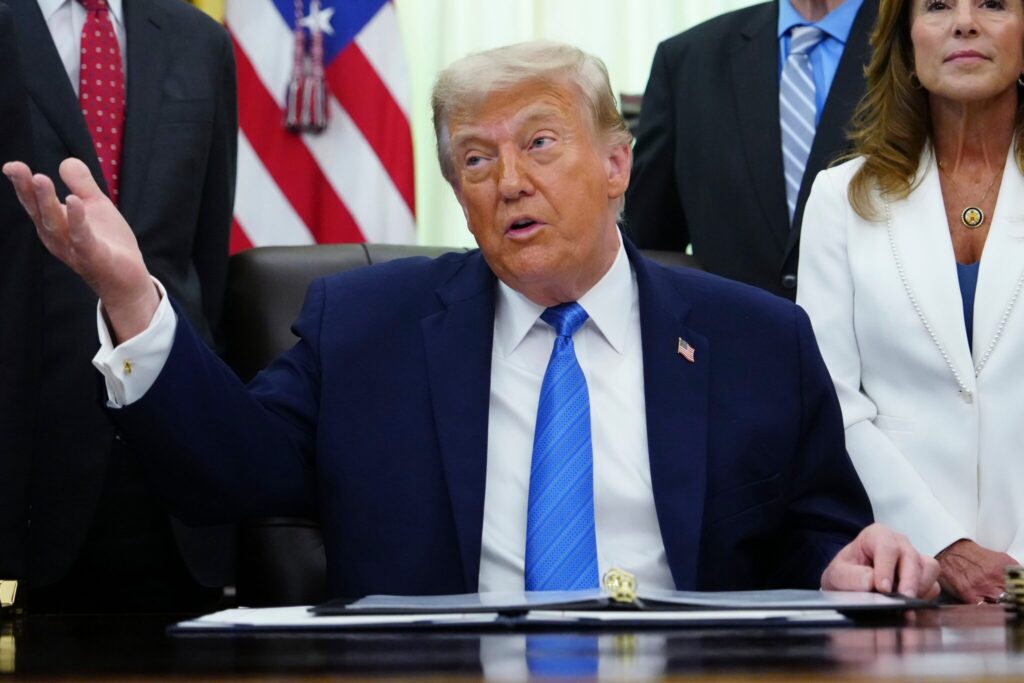
Trump Iran Oil Threat Quick Looks
- Trump threatened to hit Iran “VERY HARD TONIGHT.”
- He said the U.S. could “assume total control” of Iran’s oil and gas industries.
- Kharg Island, which handles most Iranian oil exports, was specifically mentioned.
- The U.S. and Iran exchanged strikes for a second consecutive day.
- Iran continues to maintain pressure on shipping through the Strait of Hormuz.
- U.S. forces disabled another tanker accused of transporting Iranian oil.
- Three Indian sailors were reported killed in a separate U.S. strike earlier this week.
- Kuwait, Bahrain and Jordan have all faced Iranian attacks during the conflict.
- Oil prices remain elevated amid concerns over global energy supplies.
- Diplomatic efforts to secure a broader peace agreement remain stalled.
Trump Iran Oil Threat Quick Looks
Trump Escalates Pressure on Iran With New Oil Industry Threat
President Donald Trump intensified his rhetoric against Iran on Thursday, warning that the United States could launch major military operations and eventually take control of Iran’s energy industry if negotiations remain stalled.
In a social media post, Trump said the United States would strike Iran “VERY HARD TONIGHT” and predicted that America would “assume total control” of Iran’s oil and gas infrastructure in the future.
“Yeah, there will be more bombing tonight,” Trump told Fox News in a phone interview, adding that the bombs would be “bigger, more powerful.”
Trump said taking Kharg Island, a major oil hub in the Strait of Hormuz, has been his “preference” but told Fox News “I don’t know that America has the stomach, I think they’d like to see us come home.”
Trump said Iran is “dying to make a deal,” while he personally would “like to get a deal now, less than three or four weeks ago.”
The comments marked one of the strongest public statements Trump has made since hostilities between Washington and Tehran escalated again this week.
His remarks came after two consecutive days of military exchanges between the United States and Iran, raising fears that the fragile ceasefire established earlier this year could collapse entirely.
Kharg Island Emerges as Key Target
Among the locations highlighted by Trump was Kharg Island, the strategic hub of Iran’s oil export industry.
The island serves as the primary outlet for Iranian crude shipments, with approximately 90% of the country’s oil exports passing through its facilities.
Its importance stems largely from Iran’s shallow coastline, which limits access for large tanker vessels elsewhere.
Despite its economic significance, military experts note that Kharg Island’s proximity to the Iranian mainland makes it especially vulnerable to retaliation.
The island lies roughly 33 kilometers (21 miles) from Iranian territory, placing any foreign military presence within range of Iranian missiles, drones and artillery systems.
Trump compared his vision for Iran’s energy sector to recent U.S. actions in Venezuela, where Washington dramatically expanded influence following the capture of former President Nicolás Maduro earlier this year.
Conflict Pushes Region Closer to War
The latest escalation followed another night of military operations involving both countries.
The United States launched airstrikes across multiple locations inside Iran, while Tehran continued attacks against regional states hosting American military facilities.
The exchanges marked the third major confrontation this week.
Earlier fighting involved direct attacks between Iran and Israel before the conflict expanded into a broader U.S.-Iran confrontation.
Analysts warn that continued escalation could trigger a much wider regional war involving multiple governments and militant groups throughout the Middle East.
The increasingly unstable security environment has already affected energy markets, shipping lanes and diplomatic efforts to reach a negotiated settlement.
Strait of Hormuz Remains at Center of Crisis
At the core of the dispute remains the Strait of Hormuz, one of the world’s most important maritime chokepoints.
The narrow waterway traditionally handles a substantial share of global oil and natural gas exports.
Iran has heavily restricted traffic through the strait since the conflict intensified, disrupting international energy supplies and contributing to higher fuel prices worldwide.
Tehran announced Thursday that the strait was officially closed.
However, the practical implications of the declaration remain uncertain because shipping traffic had already been severely reduced in recent months.
The U.S. military disputed Iran’s claim that the waterway is fully closed and maintains that commercial traffic continues to move through portions of the corridor.
Trump also claimed Wednesday that the U.S. military has quietly assisted oil shipments through the region despite Iranian efforts to disrupt trade.
Trump Claims Secret Oil Operation
According to Trump, American forces have conducted a covert operation aimed at moving oil shipments safely through the Strait of Hormuz.
The president claimed more than 100 million barrels of oil have bypassed Iran’s restrictions thanks to U.S. efforts.
Trump attributed the success to the destruction of Iranian radar installations and coordinated military support.
No independent confirmation of the reported figure has been provided.
Energy analysts note that 100 million barrels would represent approximately five days of normal prewar oil traffic through the strait.
Nevertheless, the claim highlights Washington’s determination to maintain energy flows despite increasing regional instability.
US Continues Maritime Blockade Operations
The U.S. military also intensified enforcement of its blockade targeting Iranian oil exports.
According to U.S. Central Command, American forces disabled another tanker allegedly attempting to transport Iranian oil in violation of the blockade.
The vessel, identified as the Guinea-Bissau-flagged M/T Jalveer, was reportedly struck late Wednesday after failing to comply with American orders.
Military officials said Hellfire missiles were used to disable the ship.
The incident marked the ninth merchant vessel targeted by U.S. forces since the blockade began in April.
Two of those incidents occurred this week alone.
American officials maintain that all actions were conducted after warnings were issued to the vessels involved.
Deaths of Indian Sailors Draw International Concern
The maritime campaign has also generated international criticism.
India confirmed Thursday that three Indian sailors were killed following a separate U.S. attack earlier this week on the tanker M/T Settebello.
The sailors were initially reported missing after the strike before their deaths were confirmed.
The incident prompted a diplomatic protest from New Delhi.
India’s Foreign Ministry summoned a senior American diplomat and expressed what officials described as the country’s “deepest concerns” regarding the attack.
The head of the International Maritime Organization also condemned the incident, raising additional questions about maritime safety in the increasingly volatile region.
The deaths underscore the risks faced by civilian shipping crews operating near the Strait of Hormuz.
Nuclear Dispute Continues to Block Peace Deal
Despite military escalation, the central dispute remains Iran’s nuclear program.
The United States and Israel insist that Iran’s stockpile of highly enriched uranium represents a serious proliferation threat.
Washington argues that preventing Iran from obtaining nuclear weapons remains a primary objective of the conflict.
Iran continues to reject those accusations and insists its nuclear program is designed solely for peaceful civilian purposes.
Tehran has refused demands to surrender its enriched uranium stockpile and continues to seek sanctions relief and access to frozen financial assets as part of any agreement.
These competing demands have stalled negotiations despite months of diplomatic efforts.
Regional Fighting Complicates Diplomacy
Another obstacle to a broader settlement involves the conflict in Lebanon.
Iran has repeatedly stated that any agreement must include an end to fighting between Israel and Hezbollah.
Israeli Prime Minister Benjamin Netanyahu has signaled little willingness to accept such conditions, maintaining that dismantling Hezbollah remains a central strategic goal.
As a result, negotiators face multiple interconnected conflicts that must be resolved simultaneously.
Those overlapping disputes have made a quick diplomatic breakthrough increasingly difficult.
Markets Watch for Next Move
Global markets continue monitoring developments closely.
Oil prices remain elevated due to fears of prolonged disruption in Middle Eastern energy supplies.
Any direct attack on Kharg Island or additional restrictions in the Strait of Hormuz could significantly affect global energy markets and inflation trends.
For now, Trump’s latest warning represents another dramatic escalation in an already volatile conflict.
Whether the threat leads to further military action or renewed diplomatic momentum remains uncertain as both sides continue to test the limits of the fragile ceasefire.